MCQ
From the ground state electronic configuration of the elements given below, pick up the  one with highest value of second ionization energy
  • A
    $1s^2\, 2s^2 \,2p^6 \,3s^2$
  • $1s^2\,2s^2\, 2p^6 \,3s^1$
  • C
    $1s^2 \,2s^2 \,2p^6$
  • D
    $1s^2\, 2s^2 \,2p^5$

Answer

Correct option: B.
$1s^2\,2s^2\, 2p^6 \,3s^1$
b

Need a full question paper?

Generate a complete, print-ready paper with questions like this in minutes — across 16+ boards, with answer keys.

Start Generating Free

Similar questions

The distillation technique most suited for separating glycerol from spent-lye in the soap industry is:
Which salt will give basic solution on hydrolysis
Which of the following has smallest bond angle
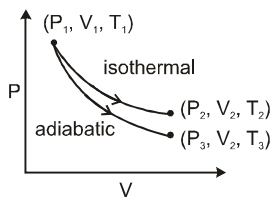
The reversible expansion of an ideal gas under adiabatic and isothermal conditions is shown in the figure. Which of the following statement$(s)$ is (are) correct? $Image$ 

$(A)$ $T _1= T _2$ $(B)$ $T _3> T _1$

$(C)$ $W _{\text {isothermal }} > W _{\text {adiabatic }}$ $(D)$ $\Delta U_{\text {isothermal }}>\Delta U_{\text {adiabatic }}$
Which of these substances is a good reducing agent
${C_{{\rm({daimond})}}}$ $+$ ${O_2} \to C{O_2};$ $\Delta H = - 395.3\,kJ/mole$

${C_({graphite)}} + {O_2} \to C{O_2};\,\Delta H = - 393.4\,kJ/mole$

${C_({graphite})} \to {C_{{\rm({diamond})}}};\,\Delta H = $
An amount of solid $N{H_4}HS$ is placed in a flask already containing ammonia gas at a certain temperature and $0.50$ $atm.$ pressure. Ammonium hydrogen sulphide decomposes to yield $N{H_3}$ and ${H_2}S$ gases in the flask. When the decomposition reaction reaches equilibrium, the total pressure in the flask rises to $0.84$ $atm$. The equilibrium constant for $N{H_4}HS$ decomposition at this temperature is
IUPAC name of the compound:
$\ \ \ \ \ \ \ \ \ \ \ \ \ \ \ \ \ \ \ \ \ \ \ \ \ \ \ \ \ \ \ \ \ \ \ \ \ \ \text{CH}_3\\\ \ \ \ \ \ \ \ \ \ \ \ \ \ \ \ \ \ \ \ \ \ \ \ \ \ \ \ \ \ \ \ \ \ \ \ \ \ \ \ \ \ |\\\text{CH}_3-(\text{CH}_2)_4-\text{CH}-\text{C}-\text{CH}_3\\\ \ \ \ \ \ \ \ \ \ \ \ \ \ \ \ \ \ \ \ \ \ \ \ \ \ \ \ \ \ \ \ \ \ \ \ \ \ \ \ \ \ |\\\ \ \ \ \ \ \ \ \ \ \ \ \ \ \ \ \ \ \ \ \ \ \ \ \ \ \ \ \text{C}_2\text{H}_5(\text{CH}_2)_2-\text{CH}_3$
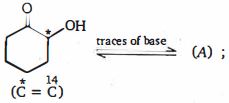
Unknown compound $(A)$ is
Bauxite containing impurities of iron oxide is purified by