MCQ
Froth flotation method is used for the concentration of:
  • A
    Oxide ores
  • Sulphide ores
  • C
    Sulphate ores
  • D
    Halide ores

Answer

Correct option: B.
Sulphide ores
roth floatation is based on the principle of the difference in the wetting properties of the ore and gangue particles with the water and oil. This method is used for those metals whose ore gets preferably wet by the oil and the gangue by the water. The sulphide ores get preferably wet by the oil and the gangue with the water.

Need a full question paper?

Generate a complete, print-ready paper with questions like this in minutes — across 16+ boards, with answer keys.

Start Generating Free

Similar questions

In which of the following reaction $2^o$ alcohol is obtained as a product ?
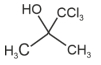
Reaction of iso-propylbenzene with $O _2$ followed by the treatment with $H _3 O ^{+}$forms phenol and a by-product $P$. Reaction of $P$ with $3$ equivalents of $Cl _2$ gives compound $Q$. Treatment of $Q$ with $Ca ( OH )_2$ produces compound $R$ and calcium salt $S$.

The correct statement($s$) regarding $P , Q , R$ and $S$ is(are)

$(A)$ Reaction of $P$ with $R$ in the presence of $KOH$ followed by acidification gives

$(B)$ Reaction of $R$ with $O _2$ in the presence of light gives phosgene gas

$(C)$ $Q$ reacts with aqueous $NaOH$ to produce $Cl _3 CCH _2 OH$ and $Cl _3 CCOONa$

$(D)$ $S$ on heating gives $P$
A button cell used in watches function as following.

$Zn_{(s)} + Ag_2O_{(s)} + H_2O_{(l)} \rightleftharpoons  $$2Ag_{(s)} + Zn^{2+}_{(aq)}+ 2OH^-_{(aq)}$

If half cell potentials are

$Zn^{2+}_{(aq)} + 2e^- \rightarrow Zn_{(s)}\,;\,\, E^o = - 0.76\, V$

$Ag_2O_{(s)} + H_2O_{(l)} + 2e^- \rightarrow 2Ag_{(s)} + 2OH^-_{(aq)}\,,$$E^o = 0.34\, V$

The cell potential will be ........... $V.$

To prepare $\ce{XeF_6}$​ at $573K, 50 - 60\ atm$ pressure, the ratio of xenon and fluorine used is:
An optically active alcohol of formula $C_9H_{12}O_2$ produced the following  compound when refluxed with $KMnO_4$

What is structure of $(A)$ ?

The original compound showed these properties also :

$\mathop {{C_9}{H_{12}}{O_2}}\limits_{(A)} \,\xrightarrow{{Na}}\,{H_2}$  liberated

$\mathop {{C_9}{H_{12}}{O_2}}\limits_{(A)} \,\xrightarrow{{Br}}$  no rapid reaction

$\mathop {{C_9}{H_{12}}{O_2}}\limits_{(A)} \,\xrightarrow[{cool}]{{Cr{O_3}\,/\,{H^ + }}}{C_9}{H_8}{O_3}$

The reaction $\text{Ar}\stackrel{+}{\hbox{N}_2}\text{Cl}^-\xrightarrow{\ \ \text{Cu/HCl}\ \ \ }\text{ArCl}+\text{N}_2+\text{CuCl}$ is named as:
Which noble gas is most soluble in water
(image) $\xrightarrow[Cold\,dil.]{KMn{{O}_{4}}/\overset{\Theta }{\mathop{O}}\,H}X\xrightarrow{HI{{O}_{4}}}Y\xrightarrow{\overset{\Theta }{\mathop{O}}\,H/\Delta }Z;\,Z$ is
The relative lowering of vapour pressure produced by dissolving $71.5\,g$ of a substance in $1000\,g$ of water is $ 0.00713.$  The molecular weight of the substance will be
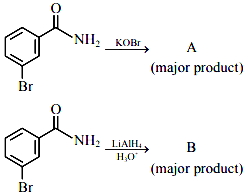
In the above reactions, product $A$ and product $B$ respectively are :