MCQ
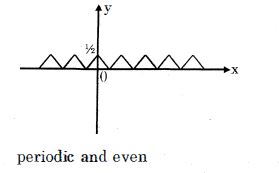
Function $f(x) = {\left( {\left\{ x \right\} - \frac{1}{2}} \right)^2}$ is (where $\{.\}$ represents fractional part function)
  • A
    discontinuous
  • B
    always differentiable
  • C
    non-periodic
  • even

Answer

Correct option: D.
even
d

Need a full question paper?

Generate a complete, print-ready paper with questions like this in minutes — across 16+ boards, with answer keys.

Start Generating Free

Similar questions

$\int_{}^{} {\frac{{{x^2}}}{{{{(x\sin x + \cos x)}^2}}}\;dx = } $
If $\left[\begin{array}{cc}1 & -\tan \theta \\ \tan \theta & 1\end{array}\right]\left[\begin{array}{cc}1 & \tan \theta \\ -\tan \theta & 1\end{array}\right]^{-1}=\left[\begin{array}{cc}a & -b \\ b & a\end{array}\right]$, then
Choose the correct answer from the given four options.

Which of the following is the principal value branch of cos-1x?

  1. $\Big[\frac{-\pi}{2},\frac{\pi}{2}\Big]$

  2. $(0,\pi)$

  3. $[0,\pi]$

  4. $(0,\pi)-\Big\{\frac{\pi}{2}\Big\}$

Three boys and two girls stand in a queue. The probability, that the number of boys ahead of every girl is at least one more than the number of girls ahead of her, is
The position vectors of $A $ and $ B$  are $i - j + 2k$ and $3i - j + 3k.$ The position vector of the middle point of the line  $ AB$  is
The solution of the equation $\frac{{dy}}{{dx}} = \frac{{x + y}}{{x - y}}$ is
The value of a so that the sum of the squares of the roots of the equation ${x^2} - (a - 2)x - a + 1 = 0$ assume the least value, is
If $A$ and $B$ are two events such that $P ( A )=\frac{1}{3}, P ( B )=\frac{1}{5} $ and $P ( A \cup B )=\frac{1}{2}$, then $P \left( A \mid B ^{\prime}\right)+ P \left( B \mid A ^{\prime}\right)$ is equal to
If $A=\left[\begin{array}{ll}0 & 2 \\ 2 & 0\end{array}\right]$, then $A^2$ is equal to
Which of the following statements about an LP problem and its dual is false?
  1. If the primal and the dual both have optimal solutions, the objective function values for both problems are equal at the optimum.
  2. If one of the variables in the primal has unrestricted sign, the corresponding constraint in the dual is satisfied with equality.
  3. If the primal has an optimal solution, so has the dual.
  4. The dual problem might have an optimal solution, even though the primal has no (bounded) optimum.