MCQ
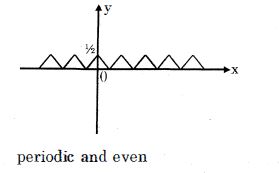
Function $f(x) = {\left( {\left\{ x \right\} - \frac{1}{2}} \right)^2}$ is (where $\{.\}$ represents fractional part function)
  • A
    discontinuous
  • B
    always differentiable
  • C
    non-periodic
  • even

Answer

Correct option: D.
even
d

Need a full question paper?

Generate a complete, print-ready paper with questions like this in minutes — across 16+ boards, with answer keys.

Start Generating Free

Similar questions

The function $f(x) = {{\log x} \over x}$ is increasing in the interval
$P$  is the point of intersection of the diagonals of the parallelogram  $ABCD.$  If  $O $ is any point, then $\overrightarrow {OA} + \overrightarrow {OB} + \overrightarrow {OC} + \overrightarrow {OD} = $
Let $A = \left\{ {\left( {x,y} \right):{y^2} \le 4x,y - 2x \ge  - 4} \right\}$ .The area of the region $A$ is
If $\int\frac{\text{x}^3\text{dx}}{\sqrt{1+\text{x}^2}}=\text{a}(1+\text{x}^2)^{\frac{3}{2}}+\text{b}\sqrt{1+\text{x}^2}+\text{c,}$ then:
Let $A$ and $B$ be $3 \times 3$ real matrices such that $A$ is symmetric matrix and $B$ is skew-symmetric matrix. Then the system of linear equations $\left( A ^{2} B ^{2}- B ^{2} A ^{2}\right) X = O ,$ where $X$ is a $3 \times 1$ column matrix of unknown variables and $O$ is a $3 \times 1$ null matrix, has ....... .
${d \over {dx}}{\tan ^{ - 1}}\left[ {{{\cos x - \sin x} \over {\cos x + \sin x}}} \right] = $
For $a>0,$ let the curves $C_{1}: y^{2}=a x$ and $\mathrm{C}_{2}: \mathrm{x}^{2}=$ ay intersect at origin $\mathrm{O}$ and a point $\mathrm{P}$ Let the line $\mathrm{x}=\mathrm{b}(0<\mathrm{b}<\mathrm{a})$ intersect the chord $OP$ and the $\mathrm{x}$ -axis at points $\mathrm{Q}$ and $\mathrm{R}$, respectively. If the line $x=b$ bisects the area bounded by the curves, $\mathrm{C}_{1}$ and $\mathrm{C}_{2},$ and the area of $\Delta \mathrm{OQR}=\frac{1}{2},$ then '$a$' satisfies the equation
If $y(x)$ is the solution of the differential equation $(x + 2)\frac{{dy}}{{dx}} = {x^2} + 4x - 9,\,x \ne  - 2$ and $y(0) = 0,$ then $y(-4)$ is equal to
If $\text{y}=\text{a}+\text{bx}^2,\text{a,b}$ arbitrary constants, then
If $\text{y}=(\sin^{-1}\text{x})^2,$ then $(1-\text{x}^2)\text{y}_2$ is equal to :