MCQ
Function $f(x) = x - [\,x],$ where  $[ \, ] $ shows a greatest integer. This function is
  • A
    A periodic function
  • B
    A periodic function whose period is $\frac{1}{2}$
  • A periodic function whose period is $1$
  • D
    Not a periodic function

Answer

Correct option: C.
A periodic function whose period is $1$
c
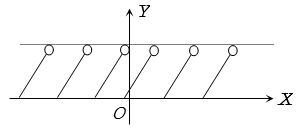
(c) It is well known fact that fractional function always a periodic function whose period is $1.$

$ - 3 \le x < - 2, - 2 \le x < - 1, - 1 \le x < 0$

$y = f(x),\,\,\,0, \le x + 3 < 1,\,\,\,0 \le x + 2 < 1$,

$0 \le x + 1 < 1$

$0 \le x < 1,\,\,1 \le x < 2$

$0 \le x < 1,\,\,0 \le x - 1 \le 1$.
Need a full question paper?

Generate a complete, print-ready paper with questions like this in minutes — across 16+ boards, with answer keys.

Start Generating Free

Similar questions

The number of non-empty subsets of the set $\{1, 2, 3, 4\}$ is
For $k \in R$, let the solutions of the equation $\cos \left(\sin ^{-1}\left(x \cot \left(\tan ^{-1}\left(\cos \left(\sin ^{-1} x\right)\right)\right)\right)\right)=k, 0\,<\,|x|<\,\frac{1}{\sqrt{2}}$ be $\alpha$ and $\beta$, where the inverse trigonometric functions take only principal values. If the solutions of the equation $x ^{2}- bx -5=0$ are $\frac{1}{\alpha^{2}}+\frac{1}{\beta^{2}}$ and $\frac{\alpha}{\beta}$, then $\frac{b}{k^{2}}$ is equal to$......$
Two cards are drawn successively with replacement from a well shuffled deck of $52$ cards then the mean of the number of aces is
The inverse of matrix $A = \left[ {\begin{array}{*{20}{c}}0&1&0\\1&0&0\\0&0&1\end{array}} \right]$ is
The line joining the points $6a - 4b + 4c,\, - 4c$ and the line joining the points $ - a - 2b - 3c,\,a + 2b - 5c$ intersect at
If $w = \frac{z}{{z - \frac{1}{3}i}}$ and $|w| = 1$, then $z$ lies on
Let $\omega$ be a complex cube root of unity with $\omega \neq 1$ and $P=\left[p_j\right]$ be a $n \times n$ matrix with $p_{i j}=\omega^{i+j}$. Then $P ^2 \neq 0$, when $n =$

$(A)$ $57$ $(B)$ $55$ $(C)$ $58$ $(D)$ $56$

If $f(x)$ is conitinuous , increasing and an odd function such that $\int\limits_{ - 1}^4 {f\left( x \right)} \,dx = 10$ and $\int\limits_0^1 {f\left( x \right)} \,dx = \frac{3}{2}$ then the area bounded by $y =f(x)$, $x -$ axis in between the ordinates $x = -4$ and $x = 4$ is
If the solution curve $f(x, y)=0$ of the differential equation $\left(1+\log _e x\right) \frac{d x}{d y}-x \log _e x=e^y, x > 0$, passes through the points $(1,0)$ and $(\alpha, 2)$ then $\alpha^\alpha$ is equal to
If ${G_1}$ and ${G_2}$ are two geometric means and $A$ the arithmetic mean inserted between two numbers, then the value of $\frac{{G_1^2}}{{{G_2}}} + \frac{{G_2^2}}{{{G_1}}}$is