MCQ
Function $f(x) = x - [\,x],$ where  $[ \, ] $ shows a greatest integer. This function is
  • A
    A periodic function
  • B
    A periodic function whose period is $\frac{1}{2}$
  • A periodic function whose period is $1$
  • D
    Not a periodic function

Answer

Correct option: C.
A periodic function whose period is $1$
c
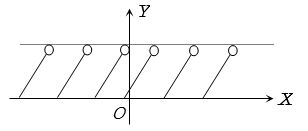
(c) It is well known fact that fractional function always a periodic function whose period is $1.$

$ - 3 \le x < - 2, - 2 \le x < - 1, - 1 \le x < 0$

$y = f(x),\,\,\,0, \le x + 3 < 1,\,\,\,0 \le x + 2 < 1$,

$0 \le x + 1 < 1$

$0 \le x < 1,\,\,1 \le x < 2$

$0 \le x < 1,\,\,0 \le x - 1 \le 1$.
Need a full question paper?

Generate a complete, print-ready paper with questions like this in minutes — across 16+ boards, with answer keys.

Start Generating Free

Similar questions

Let $f:[0,1] \rightarrow R$ (the set of all real numbers) be a function. Suppose the function $f$ is twice differentiable, $f(0)=f(1)=0$ and satisfies $f^{\prime \prime}(x)-2 f^{\prime}(x)+f(x) \geq e^x, x \in[0,1]$

$1.$ Which of the following is true for $0 < x < 1$ ?

$(A)$ $0 < $ f(x) $ < \infty$

$(B)$ $-\frac{1}{2} < f(x) < \frac{1}{2}$

$(C)$ $-\frac{1}{4} < f(x) < 1$

$(D)$ $-\infty < $ f $($ x $) < 0$

$2.$ If the function $e^{-x} f(x)$ assumes its minimum in the interval $[0,1]$ at $x=\frac{1}{4}$, which of the following is true?

$(A)$ $f^{\prime}(x)$

$(B)$ $f^{\prime}(x)>f(x), 0$

$(C)$ f $^{\prime}(x)$

$(D)$ $f^{\prime}(x)$

Give the answer question $1$ and $2.$

If $\int_{}^{} {\frac{{f(x)\;dx}}{{\log \sin x}} = \log \log \sin x} $, then $f(x) = $
The scalars $l $ and  $m$  such that $la + mb = c,$ where $ a, b $ and $  c $ are given vectors, are equal to
The area of the triangle having vertices as $i - 2j + 3k,$ $\, - 2i + 3j + k$ , $4i - 7j + 7k$ is
Let $I_n=\int_0^{\pi / 2} x^n \cos x d x$, where $n$ is a non-negative integer. Then, $\sum \limits_{n=2}^{\infty}\left(\frac{I_n}{n !}+\frac{I_n-2}{(n-2) !}\right)$ equals
The number of commutative binary operation that can be defined on a set of 2 elements is:
  1. 8
  2. 6
  3. 4
  4. 2
The co-ordinates of a point $P$ are $(3, 12, 4)$ with respect to origin $O$, then the direction cosines of $OP$ are
Let $A$ be a square matrix such that $A A^T=I$. Then $\frac{1}{2} A\left[\left(A+A^T\right)^2+\left(A-A^T\right)^2\right]$ is equal to
The value of $\int_{\pi /4}^{3\pi /4} {\frac{\phi  }{{1 + \sin \phi  }}\,d\phi   ,} $ is
For any integer $n,$ the integral  $\int_0^\pi {{e^{{{\sin }^2}x}}{{\cos }^3}(2n + 1)x\,dx = } $