MCQ
Function $f(x)={\left( {1 + \frac{1}{x}} \right)^x}$ then Domain of $f (x)$ is
  • A
    $(-1, 0) \cup (0, \infty )$
  • B
    $R - { 0 }$
  • $(-\infty , -1) \cup (0, \infty )$
  • D
    $(0, \infty )$

Answer

Correct option: C.
$(-\infty , -1) \cup (0, \infty )$
c

Need a full question paper?

Generate a complete, print-ready paper with questions like this in minutes — across 16+ boards, with answer keys.
Start Generating Free

Similar questions

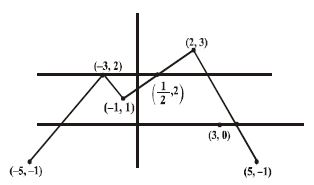
The graph of $y = f(x)$ is shown then number of solutions of the equation $f(f(x)) =2$ is
For which of the following ordered pairs $(\mu, \delta)$ the system of linear equations  $x+2 y+3 z=1$ ; $3 x+4 y+5 z=\mu$ ; $4 x+4 y+4 z=\delta$ is inconsistent?
Let $f: R \rightarrow R$ be a function such that $f(x+y)=f(x)+f(y), \quad \forall x, y \in R .$ If $f(x)$ is differentiable at $x=0$, then

$(A)$ $f(x)$ is differentiable only in a finite interval containing zero

$(B)$ $f(x)$ is continuous $\forall x \in R$

$(C)$ $f^{\prime}(x)$ is constant $\forall x \in R$

$(D)$ $f(x)$ is differentiable except at finitely many points

$\int_{}^{} {\left( {\frac{{2 + \sin 2x}}{{1 + \cos 2x}}} \right)\,\,{e^x}dx = } $
The sum of the order and the degree of the differential equation $\frac{d}{d x}\left(\frac{d y}{d x}\right)^3$ is
If $y = a\cos \left( {\ln x} \right) + b\sin \left( {\ln x} \right)$, then ${x^2}\frac{{{d^2}y}}{{d{x^2}}} + x\frac{{dy}}{{dx}}$ is equal to
The solution of the differential equation $\frac{\text{dy}}{\text{dx}}=\frac{\text{y}}{\text{x}}+\frac{\phi(\frac{\text{y}}{\text{x}})}{\phi'(\frac{\text{y}}{\text{x}})}$ is:
Let $\text{X}=\begin{bmatrix}\text{x}_1\\\text{x}_2\\\text{x}_3\end{bmatrix},\text{A}=\begin{bmatrix}1&-1&2\\2&0&1\\3&2&1\end{bmatrix}$ and $\text{B}=\begin{bmatrix}3\\1\\4\end{bmatrix}$. If $AX = B,$ then $X$ is equal to:
The integrating factor of the differential equation $(\text{x}\log\text{x})\frac{\text{dy}}{\text{dx}}+\text{y}=2\ \log\text{x}$ is given by:
Let $a, b$ and $c$ be positive constants. The value of $‘a’$ in terms of $‘c’$ if the value of integral $\int\limits_0^1 {(ac{x^{b + 1}} + {a^3}b{x^{3b + 5}})\,dx} $ is independent of $b$ equals