MCQ
Function of rectifier is
  • To convert $ac$  into $ dc$ 
  • B
    To convert $dc $ into $ac$ 
  • C
    Both $ (a)$ and $ (b)$
  • D
    None of these

Answer

Correct option: A.
To convert $ac$  into $ dc$ 
a
(a) $ac$ $\Rightarrow $ Rectifier $\Rightarrow $ $dc$

Need a full question paper?

Generate a complete, print-ready paper with questions like this in minutes — across 16+ boards, with answer keys.

Start Generating Free

Similar questions

A metallic bar of Young's modulus, $0.5 \times 10^{11} \mathrm{~N} \mathrm{~m}^{-2}$ and coefficient of linear thermal expansion $10^{-5}{ }^{\circ} \mathrm{C}^{-1}$, length $1 \mathrm{~m}$ and area of cross-section $10^{-3} \mathrm{~m}^2$ is heated from $0^{\circ} \mathrm{C}$ to $100^{\circ} \mathrm{C}$ without expansion or bending. The compressive force developed in it is :
Which of the following quantities have dimensions of $\frac{{\pi {{\Pr }^4}}}{{3Ql}}:$ ( $Q =$ Volume flow rate in $m^3/s$ and $P =$ pressure)
Water is flowing through a tube of non-uniform cross-section ratio of the radius at entry and exit end of the pipe is $ 3 : 2.$  Then the ratio of velocities at entry and exit of liquid is
A fixed horizontal wire carries a current of $200 A$. Another wire having a mass per unit length ${10^{ - 2}}\ kg/m$ is placed below the first wire at a distance of $2 \ cm$ and parallel to it. How much current must be passed through the second wire if it floats in air without any support? What should be the direction of current in it
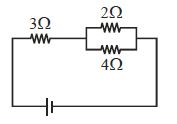
If power in $3\,\Omega $ is $27\,W$ then what is the power in $2\,\Omega $  ................ $\mathrm{W}$
Which of the following statements is/are not an assumption of the kinetic theory for an ideal gas?
An atom absorbs a photon of wavelength $500\,nm$ and emits another photon of wavelength $600\,nm$. The net energy absorbed by the atom in this process is $n \times 10^{-4}\,eV$. The value of $n$ is ............ [Assume the atom to be stationary during the absorption and emission process] $\left(\right.$Take $h =6.6 \times 10^{-34}\,Js$ and $\left.c =3 \times 10^8\,m / s \right)$
A $6 \,kg$ bomb at rest explodes into three equal pieces $P, Q$ and $R$. If $P$ flies with speed $30 \,m / s$ and $Q$ with speed $40 \,m / s$ making an angle $90^{\circ}$ with the direction of $P$. The angle between the direction of motion of $P$ and $R$ is about
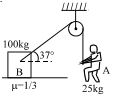
Block $B$ of mass $100 kg$ rests on a rough surface of friction coefficient $\mu = 1/3$. $A$ rope is tied to block $B$ as shown in figure. The maximum acceleration with which boy $A$ of $25 kg$ can climbs on rope without making block move is:
An electron in a hydrogen atom undergoes a transition from an orbit with quantum numebr $\mathrm{n}_i$ to another with quantum number $\mathrm{n}_f . \mathrm{V}_i$ and $\mathrm{V}_f$ are respectively the initial and final potential energies of the electon. If $\frac{\mathrm{v}_{\mathrm{i}}}{\mathrm{v}_{\mathrm{f}}}=6.25$, then the smallest possible $n_f$ is