MCQ
Fusion reaction takes place at high temperature because
  • A
    Molecules break up at high temperature
  • B
    Nuclei break up at high temperature
  • C
    Atoms get ionised at high temperature
  • Kinetic energy is high enough to overcome the coulomb repulsion between nuclei
Answer

Correct option: D.
Kinetic energy is high enough to overcome the coulomb repulsion between nuclei
d
In nuclear fusion reaction, the lighter nuclei combine together to form heavier nuclie.

Fusion reaction takes place at high temperature because kinetic energy is high enough to overcome repulsion between nuclei.

Need a full question paper?

Generate a complete, print-ready paper with questions like this in minutes — across 16+ boards, with answer keys.

Start Generating Free

Similar questions

$1000$ small water drops each of capacitance $C$ join together to form one large spherical drop. The capacitance of bigger sphere is ......... $C$
Consider a thin uniform square sheet made of a rigid material. If its side is $‘a’$ mass $m$ and moment of inertia $I$ about one of its diagonals, then
A bus appears to go with a speed of $25 \,km / hr$ to a car driver, driving at the rate $7 \,km / hr$ northwards. If the bus actually travels in east direction, its speed is ......... $km / h$
A capacitor of reactance $4 \sqrt{3} \Omega$ and a resistor of resistance $4 \Omega$ are connected in series with an ac source of peak value $8 \sqrt{2} \mathrm{~V}$. The power dissipation in the circuit is. . . . .$W$.
The electromagnetic waves do not transport
One end of a copper rod of length $1.0\;m$ and area of cross-section ${10^{ - 3}}$ is immersed in boiling water and the other end in ice. If the coefficient of thermal conductivity of copper is $92\;cal/m{\rm{ - }}s{{\rm{ - }}^o}C$ and the latent heat of ice is $8 \times {10^4}cal/kg$, then the amount of ice which will melt in one minute is
The time dependence of the position of a particle of mass $m = 2$ is given by $\vec r(t) = 2t\hat i - 3{t^2}\hat j$ Its angular momentum with respect to the origin at time $t = 2$ is
values $2.71$ and $3.70$ ohm at $10°C$ and $100°C.$ The temperature at which the resistance is $3.26$ ohm is .......... $^oC$ 
A source of frequency $\nu$ gives $5$ beats/second when sounded with a source of frequency $200 \;Hz$. The second harmonic of frequency $2\nu$ of source gives $10$ beats/second when sounded with a source of frequency $420\; Hz$. The value of $v$ is .... $Hz$
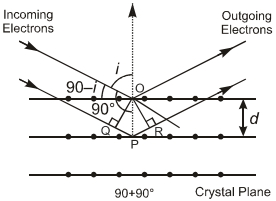
Wave property of electrons implies that they will show diffraction effects. Davisson and Germer demonstrated this by diffracting electrons from crystals. The law governing the diffraction from a crystal is obtained by requiring that electron waves reflected from the planes of atoms in a crystal interfere constructively (see figure).

Electrons accelerated by potential $V$ are diffracted from a crystal. If $d =1\; \mathring A$, and $i =30^{\circ}$. $V$ should be about ....... $V$

$\left( h =6.6 \times 10^{-34}\; J-s , m =9.1\times 10^{-31}\; kg , e =1.610^{-19} \;C \right)$