MCQ
Fusion reaction takes place at very high temperature because:
  • A
    Atoms are ionised at high temperatures
  • B
    Molecules breakup at high temperature
  • C
    Nuclei break up at high temperature
  • D
    Kinetic energy is high enough to overcome repulsion between nuclei
Answer

  1. Kinetic energy is high enough to overcome repulsion between nuclei

Explanation:

Fusion reactions takes place at temperature about 107K it requires this high temperature so that nucleus are moving at very high speed, so that they have high kinetic energy and can overcome the repulsion between nuclei and come together.

Need a full question paper?

Generate a complete, print-ready paper with questions like this in minutes — across 16+ boards, with answer keys.

Start Generating Free

Similar questions

If an element X has mass number and number of proton 8 then identify element X :

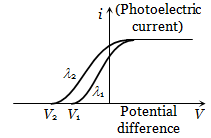
In the following diagram if V2 > V1 then

(a)  

(b)  

(c)  

(d)   

The phenomena of total internal reflection is seen when angle of incidence is

(a) 90°     

(b) Greater than critical angle

(c) Equal to critical angle

(d) 0°       

3.8 days is the half-life period of a sample. After how many days, the sample will become 1/8th of the original substance

(a) 11.4

(b) 3.8

(c) 3  

(d) None of these

In electromagnetic wave, according to Maxwell, changing electric field gives.
If the electric force between two unknown charges is attractive, identify which of the following statement must be true?
A freshly prepared radioactive source of half-life 2h emits radiation of intensity which is 64 times the permissible safe level. The minimum time after which it would be possible to work safely with this source is:
  1. 6h
  2. 12h
  3. 24h
  4. 128h

 and  represent mass of neutron and proton respectively. If an element having atomic mass M has N-neutron and Z-proton, then the correct relation will be

(a)  

(b)  

(c)  

(d)  

A P-type semiconductor has acceptor levels 57 meV above the valence band. The maximum wavelength of light required to create a hole is (Planck’s constant h = 6.6  J-s)

(a) 57  

(b) 57  

(c) 217100

(d) 11.61  

In a thermocouple, the temperature that does not depend on the temperature of the cold junction is called

(a) Neutral temperature

(b) Temperature of inversion

(c) Both the above

(d) None of the above



