- AAtoms are ionised at high temperature.
- BMolecules break up at high temperature.
- CNuclei break up at high temperature.
- DKinetic enrgy is high enough to overcome repulsion between nuclei.
Generate a complete, print-ready paper with questions like this in minutes — across 16+ boards, with answer keys.
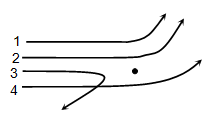
The diagram shows the path of four a-particles of the same energy being scattered by the nucleus of an atom simultaneously. Which of these are/is not physically possible

|
(a) 3 and 4 |
(b) 2 and 3 |
(c) 1 and 4 |
(d) 4 only |
If
and
are the number of electrons and holes in a semiconductor heavily doped with phosphorus, then
|
(a) |
(b) |
(c) |
(d) |

Consider four circuits shown in the figure below. In which circuit power dissipated is greatest (Neglect the internal resistance of the power supply)
|
(a) |
(b) |
(c) |
(d) |
Putting a dielectric substance between two plates of condenser, capacity, potential and potential energy respectively
|
(a) Increase, decrease, decrease |
(b) Decrease, increase, increase |
|
(c) Increase, increase, increase |
(d) Decrease, decrease, decrease |
A LC circuit is in the state of resonance. If C = 0.1μF and L = 0.25 henry. Neglecting ohmic resistance of circuit what is the frequency of oscillations
|
(a) 1007 Hz |
(b) 100 Hz |
(c) 109 Hz |
(d) 500 Hz |
Which of the following graphs shows the variation of thermoelectric power with temperature difference between hot and cold junction in thermocouples
|
(a) |
(b) |
(c) |
(d) |
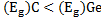
Carbon, silicon and Germanium atoms have four valence electrons each. Their valence and conduction band are separated by energy band gaps represented by (Eg)C. (Eg)Si and (Eg)Ge respectively. Which one of the following relationship is true in their case
|
(a) ( |
(b) |
(c) |
(d) |