MCQ
$f(x) = \left| {\left| x \right| - 1} \right|$ is not differentiable at
  • A
    $0$
  • $ \pm 1,\,0$
  • C
    $1$
  • D
    $ \pm \,1$

Answer

Correct option: B.
$ \pm 1,\,0$
b
(b )$ = \left\{ \begin{array}{l}|x| - 1,\,\,\,\,\,\,\,|x| - 1 \ge 0\\ - |x| + 1,\,\,\,|x| - 1 < 0\end{array} \right.$

$ = \left\{ \begin{array}{l}|x| - 1,\,\,\,x \le - 1\,\,{\rm{or}}\,x \ge 1\\ - |x| + 1,\,\,\,\,\,\,\, - 1 < x < 1\end{array} \right.$

$ = \left\{ \begin{array}{l} - x - 1,\,\,\,\,\,x \le - 1\\x + 1,\,\,\,\,\,\, - 1 < x < 0\\ - x + 1,\,\,\,\,\,0 \le x < 1\\\,\,x - 1,\,\,\,\,\,\,\,x \ge 1\end{array} \right.$

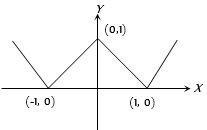
From the graph. It is clear that $f(x)$ is not differentiable at $x = - 1,\,0$ and $1$.
Need a full question paper?

Generate a complete, print-ready paper with questions like this in minutes — across 16+ boards, with answer keys.

Start Generating Free

Similar questions

If $y = {\tan ^{ - 1}}\left( {{{a\cos x - b\sin x} \over {b\cos x + a\sin x}}} \right)$ then ${{dy} \over {dx}} = $
Let $R$ be a relation in the set $N$ given by $R=\{(a, b): a=b-2, b>6\}$. Then
If $\pi \le x \le 2\pi $, then ${\cos ^{ - 1}}(\cos x)$ is equal to
If $\int\limits_1^2 {\frac{{dx}}{{{{\left( {{x^2} - 2x + 4} \right)}^{\frac{3}{2}}}}} = \frac{k}{{k + 5}}} $ then $k$ is equal to
Area of the region bounded by the curve $y = |x + 1| + 1, x = –3, x = 3$ and $y = 0$ is:
If the magnitudes of two vectors $\vec{a}$ and $\vec{b}$ are $\sqrt{3}$ and 2 respectively and $\vec{a} \cdot \vec{b}=\sqrt{6}$. Then the angle between $\vec{a}$ and $\vec{b}$ is:
The order of $\begin{bmatrix}\text{x}&\text{amp;}\text{ y}&\text{amp; }\text{z}\end{bmatrix}$ $\begin{bmatrix}\text{x} &\text{amp;}\text{ h}&\text{amp;}\text{ g} \\\text{h} &\text{amp;}\text{ b}&\text{amp; }\text{f}\\\text{g} &\text{amp;}\text{ f}&\text{amp; }\text{c} \end{bmatrix}\begin{bmatrix}\text{x}\\\text{y}\\\text{z}\end{bmatrix}$ is :
Let $P ( x )$ be a real polynomial of degree $3$ which vanishes at $x =-3 .$ Let $P ( x )$ have local minima at $x=1,$ local maxima at $x=-1$ and $\int_{-1}^{1} P ( x ) d x =18,$ then the sum of all the coefficients of the polynomial $P ( x )$ is equal to ....... .
The system of equations $\begin{array}{l}\alpha x + y + z = \alpha - 1\\x + \alpha y + z = \alpha - 1\\x + y + \alpha z = \alpha - 1\end{array}$ has no solution, if $\alpha $ is
$\frac{1}{2}{\cos ^{ - 1}}\left( {\frac{{1 - x}}{{1 + x}}} \right) = $