MCQ
GaAs is
  • A
    Element semiconductor
  • Alloy semiconductor
  • C
    Bad conductor
  • D
    Metallic semiconductor

Answer

Correct option: B.
Alloy semiconductor
b
(b)

Need a full question paper?

Generate a complete, print-ready paper with questions like this in minutes — across 16+ boards, with answer keys.
Start Generating Free

Similar questions

The valence band and conduction band of a solid overlap at low temperature, the solid may be
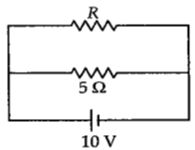
he power dissipated in the circuit shown in the figure is $30\,W$. The value of $R$  is ............. $\Omega$
A $20 \,cm$ length of a certain solution causes right-handed rotation of $38^o $. A $30\,cm $ length of another solution causes left-handed rotation of $24^o $. The optical rotation caused by $30\,cm$ length of a mixture of the above solutions in the volume ratio $1 : 2$ is
Nuclear fission was discovered by
Tesla is the unit of
A charged particle of mass $m$ and charge $q$ travels on a circular path of radius $r$ that is perpendicular to a magnetic field $B$. The time taken by the particle to complete one revolution is
Consider two separate ideal gases of electrons and protons having same number of particles. The temperature of both the gases are same. The ratio of the uncertainty in determining the position of an electron to that of a proton is proportional to :-
The Bohr model of atoms
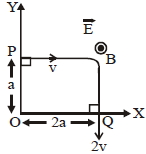
A charged particle of mass $\mathrm{m}$ and charge $q$ moving under the influence of uniform electric field $E\hat{i }$ and a uniform magnetic field $B\hat{k}$ follows a trajectory from point $\mathrm{P}$ to $\mathrm{Q}$ as shown in figure. The velocities at $P$ and $Q$ are respectively, $v\hat i$ and $-2 v \hat j$. Then which of the following statements $(\mathrm{A}, \mathrm{B}, \mathrm{C}, \mathrm{D})$ are the correct $?$ (Trajectory shown is schematic and not to scale)

$(A)$ $\mathrm{E}=\frac{3}{4}\left(\frac{\mathrm{mv}^{2}}{\mathrm{qa}}\right)$

$(B)$ Rate of work done by the electric field at $\mathrm{P}$ is $\frac{3}{4}\left(\frac{\mathrm{mv}^{3}}{\mathrm{a}}\right)$

$(C)$ Rate of work done by both the fields at $\mathrm{Q}$ is zero

$(D)$ The difference between the magnitude of angular momentum of the particle at $\mathrm{P}$ and $Q$ is $2 mav$.
The direction of line of magnetic field of bar magnet is