Question
$\gamma - \text{rays}$ are deflected by:

Answer

  1. Neither by electric field nor by magnetic field.

Need a full question paper?

Generate a complete, print-ready paper with questions like this in minutes — across 16+ boards, with answer keys.
Start Generating Free

Similar questions

The $21 \ cm$ radio wave emitted by hydrogen in interstellar space is due to the interaction called the hyperfine interaction is atomic hydrogen. the energy of the emitted wave is nearly
Heat of 80 J is produced in a conductor on passing a current of 2 A for 10 seconds. The resistance of conductor will be:
A ray of light falls on the surface of a spherical glass paper weight making an angle α with the normal and is refracted in the medium at an angle β. The angle of deviation of the emergent ray from the direction of the incident ray(a) (α  - β)(b) 2(α- β)(c) (α – β)/2(d) (β - α)
       
A galvanometer has a resistance of 25 ohm and a maximum of 0.01 A current can be passed through it.  In order to change it into an ammeter of range 10 A, the shunt resistance required is(a) 5/999 ohm(b) 10/999 ohm(c) 20/999 ohm(d) 25/999 ohm
       
If a bar magnet of magnetic moment M is freely suspended in a uniform magnetic field of strength B, the work done in rotating the magnet through an angle θ is(a) MB(1- sinθ(b) MB sinθ(c) MB cosθ(d) MB(1 – cosθ)
       
According to the quantum theory of light, the energy of light is carried in discrete units called:
A spectral line $\lambda = 5000 \mathring A $  in the light coming from a distant star is observed as a $5200 \mathring A .$ What will be recession velocity of the star
The electric potential at the surface of an atomic nucleus $(Z=50)$ of radius $9.0 \times 10^{-13} cm$ is
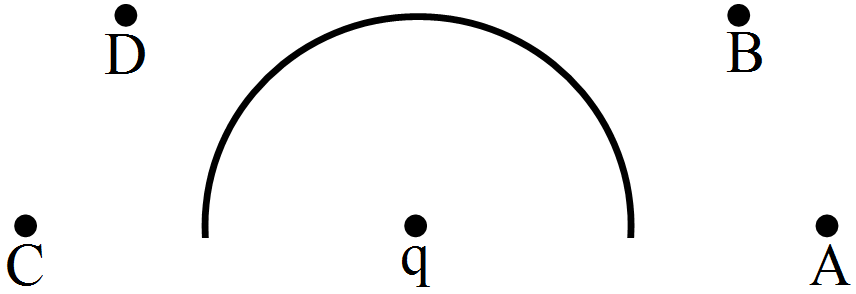
Figure shows a charge q placed at the centre of a hemisphere. A second charge Q is placed at one of the positions A, B, C and D. In which position(s) of this second charge, the flux of the electric field through the hemisphere remains unchanged?
  1. A
  2. B
  3. C
  4. D
What is the effect on null deflection of galvanometer, when the radius of the wire is tripled?