MCQ
Gauss's law in dielectric medium:
  • $\oint \epsilon_1 E d s=\frac{q}{\epsilon_0}$
  • B
    $\oint E d s=\frac{q}{\epsilon_0}$
  • C
    $\oint \frac{E d s}{\epsilon_1}=\frac{q}{\epsilon_0}$
  • D
    $\oint E d s=0$

Answer

Correct option: A.
$\oint \epsilon_1 E d s=\frac{q}{\epsilon_0}$
(a)$\oint \epsilon_1 E d s=\frac{q}{\epsilon_0}$

Need a full question paper?

Generate a complete, print-ready paper with questions like this in minutes — across 16+ boards, with answer keys.
Start Generating Free

Similar questions

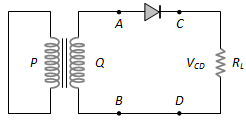
In the half-wave rectifier circuit shown. Which one of the following wave forms is true for $\mathrm{V}_\mathrm{CD}$, the output across C and D ?
Assertion : A red object appears dark in the yellow light
Reason : A red colour is scattered less
The deflection in moving coil galvanometer falls from $25$ divisions to $5$ division when a shunt of $24\  \Omega$ is applied. The resistance of galvanometer coil will be :
If the resistance of a conductor is $5 W$ at $50^{\circ} \mathrm{C}$ and $7 W$ at $100^{\circ} \mathrm{C}$ then the mean temperature coefficient of resistance of the material is
 
The phase difference between the alternating current and emf is $\frac{\pi }{2}$ .Which of the following cannot be the constituent of the circuit?
Ten identical cells connected in series are needed to heat a wire of length one meter and radius $‘r’$ by $10^\circ C$ in time $‘t’.$ How many cells will be required to heat the wire of length two meter of the same radius by the same temperature in time $‘t’$?
A beam of natural light falls on a system of $6$ polaroids, which are arranged in succession such that each polaroid is turned through $30^o $ with respect to the preceding one. The percentage of incident intensity that passes through the system will be....$\%$
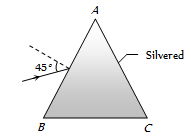
A prism ABC of angle 30° has its face AC silvered. A ray of light incident at an angle of 45° at the face AB retraces its path after refraction at face AB and reflection at face AC. The refractive index of the material of the prism is
A paramagnetic material is kept in a magnetic field. The field is increased till the magnetization becomes constant. If the temperature is now decreased, the magnetization
In a concave mirror experiment, an object is placed at a distance $X_1$ from the focus and the image is formed at a distance $X_2$ from the focus. The focal length of the mirror would be