MCQ
Gauss’s law is true for.
  • Any closed surface.
  • B
    For particular surfaces
  • C
    Both $a$ and $b.$
  • D
    None.

Answer

Correct option: A.
Any closed surface.

Need a full question paper?

Generate a complete, print-ready paper with questions like this in minutes — across 16+ boards, with answer keys.
Start Generating Free

Similar questions

An ammeter reads upto $1\, ampere$. Its internal resistance is $0.81\, ohm$. To increase the range to $10\, A$ the value of the required shunt is ............ $\Omega $
Assertion : A loosely round helix made of stiff wire is suspended vertically with the lower end just touching a dish of mercury. When a current is passed through the wire, the helical wire executes oscillatory motion with the lower end jumping out of and inside of mercury.
Reason : When electric current is passed through helix, a magnetic field is produced both inside and outside the helix.
A transformer is used to light $140\, watt$ $24\, volt$ lamp from $240\, volt$ $AC$ mains; the current in the main cable is $0.7\, amp$. The efficiency of the transformer is......$\%$
A semi$-$circular arc of radius $'a\ '$ is charged uniformly and the charge per unit lengths is $\lambda$. The electric field at the centre is:
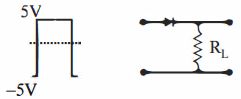
If in a $p -n$ junction diode, a square input signal of $10\ V$ is applied as shown
Equal potentials are applied on an iron and copper wire of same length. In order to have the same current flow in the two wires, the ratio r (iron)/r (copper) of their radii must be (Given that specific resistance of iron = $1.0 \times 10^{-7}$ ohm–m and specific resistance of copper = $1.7 \times 10^{-8}$ ohm-m)
An excited $He^+$ ion emits two photons in succession, with wavelengths $108.5\, nm$ and $30.4\, nm$, in making a transition to ground state. The quantum number $n$, corresponding to its initial excited state is $n=........$ (for photon of wavelength $\lambda $, energy $E = \frac{{1240\,eV}}{{\lambda \,(in\,nm)}}$)
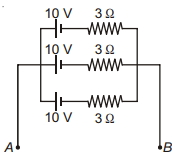
Three identical cells are connected in parallel across $A B$. Net emf across $A B$ is .......... $V$
Who first proposed the light as an electromagnetic wave?
From the given data, the amount of energy required to break the nucleus of aluminium ${ }_{13}^{27} {Al}$ is $....\,x \times 10^{-3} {J}$

Mass of neutron $=1.00866 \,{u}$

Mass of proton $=1.00726 \,{u}$

Mass of aluminium nucleus $=27.18846\, {u}$

(Assume $1\,u$ corresponds to $x\,J$ of energy)

(Round off to the nearest integer)