MCQ
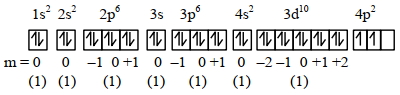
$\mathrm{Ge}(\mathrm{Z}=32)$ in its ground state electronic configuration has $\mathrm{x}$ completely filled orbitals with $\mathrm{m}_{l}=0$. The value of $\mathrm{x}$ is ..... .
  • A
    $4$
  • B
    $6$
  • C
    $5$
  • $7$

Answer

Correct option: D.
$7$
d
Completely filled orbital with $\mathrm{m}_{\ell}=0$ are

$=1+1+1+1+1+1+1$

$=7$

So Answer is $7$

Need a full question paper?

Generate a complete, print-ready paper with questions like this in minutes — across 16+ boards, with answer keys.

Start Generating Free

Similar questions

The tendency of an electrode to lose electrons is known as
Which of the following organic compounds has same hybridization as its combustion product $(CO_2)\,?$
Equivalent mass of oxidizing agent in the reaction is $SO_2 + 2H_2S \to 3S + 2H_2O$ is
The stability of carbanions in the following.

$(i)\,\,RC \equiv \mathop C\limits^ \ominus  $

$(ii)\,\,[IMAGE]$ 

$(iii)\,\,{R_2}C = \mathop C\limits^ \ominus  H$

$(iv)\,\,{R_3}C - \mathop C\limits^ \ominus  {H_2}$

An aqueous solution of potash alum gives
From the following ${E^o}$ values of half cells, what combination of two half cells would result in a cell with the largest potential ?

$\left( I \right)A + {e^ - } \to {A^\circleddash  }\,\,\,\,\,\,{E^o} =  + 0.24\,V$

$\left( {II} \right){B^ - } + {e^ - } \to {B^{ - 2}}\,\,\,\,\,\,{E^o} =  + 1.25\,V$

$\left( {III} \right){C^ - } + 2{e^ - } \to {C^{ - 3}}\,\,\,\,\,\,{E^o} =  + 0.15\,V$

$\left( {IV} \right)D + 2{e^ - } \to {D^{ - 2}}\,\,\,\,\,\,{E^o} =  + 0.68\,V$

During the qualitative analysis of $SO _3^{2-}$ using dilute $H _2 SO _4, SO _2$ gas is evolved which turns $K _2 Cr _2 O _7$ solution (acidified with dilute $H _2 SO _4$ ):
Oxidation states of $P$ in $H_4P_2O_5,\, H_4P_2O_6,\, H_4P_2O_7$, are respectively
Which has a coordinate bond
One mole of a compound $AB$ reacts with one mole of a compound $CD$ according to the equation $AB + CD$ $\rightleftharpoons$ $AD + CB$. When equilibrium had been established it was found that $\frac{3}{4}$mole each of reactant $AB$ and $CD$ had been converted to $AD$ and $CB$. There is no change in volume. The equilibrium constant for the reaction is