MCQ
General formula of paraffin is
  • A
    ${C_n}{H_{2n}}$
  • B
    ${C_n}{H_{2n - 2}}$
  • ${C_n}{H_{2n + 2}}$
  • D
    ${C_{2n}}{H_{2n}}$

Answer

Correct option: C.
${C_n}{H_{2n + 2}}$
c
${C_n}{H_{2n + 2}}$

Need a full question paper?

Generate a complete, print-ready paper with questions like this in minutes — across 16+ boards, with answer keys.

Start Generating Free

Similar questions

Formation for ammonia is shown by the reaction ${N_{2(g)}} + 3{H_{2(g)}} \to 2N{H_{3(g)}},{\Delta _r}{H^o} =  - 91.8\,kJ\,mo{l^{ - 1}}$ What will be the enthalpy of reaction for the decomposition of $NH_3$ according to the reaction $2N{H_{3(g)}} \to {N_{2(g)}} + 3{H_2};{\Delta _r}{H^o} = ?$ .....$ kJ\, mol^{-1}$
In the isoelectronic species the ionic radii $\overset{o}{\mathop{A}}\,$ of ${N^{3 - }}$, ${O^{2 - }}$ and ${F^ - }$ are respectively given by
The ions with the positive charge or negative charge will have the radius, respectively:
$C{H_4}$ is formed when
Which of the following reaction results in the formation of a pair of diastereomers ?
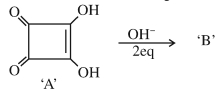
Correct statements for the given reaction are :

$A$. Compound ' $B$ ' is aromatic

$B$. The completion of above reaction is very slow

$C$. '$A$' shows tautomerism

$D$. The bond lengths $C - C$ in compound $B$ are found to be same

Choose the correct answer from the options given below :
Arrange decreasing order of reactivity of these compounds for nucleophilic substitution reaction

$(I)$ $\begin{array}{*{20}{c}}
  {\,\,\,\,\,\,\,\,\,\,\,\,\,\,\,\,\,\,\,\,\,\,\,\,O} \\ 
  {\,\,\,\,\,\,\,\,\,\,\,\,\,\,\,\,\,\,\,\,\,\,\,\,||} \\ 
  {C{H_3} - C{H_2} - O - S - C{F_3}} \\ 
  {\,\,\,\,\,\,\,\,\,\,\,\,\,\,\,\,\,\,\,\,\,\,\,||} \\ 
  {\,\,\,\,\,\,\,\,\,\,\,\,\,\,\,\,\,\,\,\,\,\,\,\,O} 
\end{array}$

$(II)$ $CH_3-CH_2-O-TsCl$

$(III)$ $\begin{array}{*{20}{c}}
  {C{H_3} - CH - C{H_3}} \\ 
  {|\,\,\,\,} \\ 
  {OH\,} 
\end{array}$

$(IV)$ $\begin{array}{*{20}{c}}
  {C{H_3} - CH - OH} \\ 
  | \\ 
  {{C_6}{H_5}} 
\end{array}$
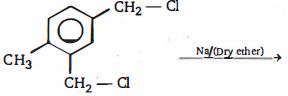
Products obtained in above Wurtz reaction is
Which of the order for ionisation energy is correct
An atom has $x$ energy level, then total number of lines in its spectrum are