MCQ
General formula of primary alcohol is
  • A
    $>CHOH$
  • B

  • $ - C{H_2}OH$
  • D

Answer

Correct option: C.
$ - C{H_2}OH$
c
(c) $-OH$  group is attached to primary carbon.

Need a full question paper?

Generate a complete, print-ready paper with questions like this in minutes — across 16+ boards, with answer keys.

Start Generating Free

Similar questions

How many atoms of calcium will be deposited from molten $CaCl_2$ by a current of $25$ milli amperes flowing for $60\, seconds$
When a certain conductivity cell was filled with $0.1\ M\  KCl$, it had a resistance of $85\  \Omega$ at $25\,^o\ C$. When the same cell was filled with an aqueous solution of $0.052\  M$ unknown electrolyte, the resistance was $96\  \Omega$. Calculate the molar conductivity of the unknown electrolyte at this concentration ............ ${\Omega ^{ - 1}}{\rm{c}}{{\rm{m}}^2}{\rm{mo}}{{\rm{l}}^{ - 1}}$ (Given : Specific conductivity of $0.1\ M\  KCl = 1.29 × 10^{-2}\ \Omega ^{-1} \ \ cm^{-1}$)
Oxidation number of As in ${H_2}AsO_4^ - $ is
When two alkyl groups are attached to the nitrogen atom in an amine, it is known as a $.......$ amine.
Two solution labelled as $3\,M\,HCl$ and $1\,M\,HCl$ are mixed in the ratio of $x : y$ by volume and the molarity of resulting solution is $1.5\,M$. ....... $M$ the molarity of the resulting solution if they are mixed in the ratio $y : x$ by volume.
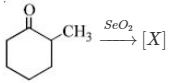
In the given reaction    $[X]$ will be :
Why $NH_3$ can’t be dried by $H_2SO_4,\, P_2O_5$ , and $CaCl_2$
In photography sodium thiosulphate is used as
$Pt|{H_2}\left( {1\,atm} \right)|{H^ + }\left( {0.001\,M} \right)||{H^ + }\left( {0.1\,M} \right)|{H_2}(1\,atm)|Pt$ What will be the value of $E_{cell}$ for this cell? ............. $\mathrm{V}$
Which of the following is not true about the voids formed in $3$ dimensional hexagonal close packed structure?
$a.$ A tetrahedral void is formed when a sphere of the second layer is present above triangular void in the first layer.
$b.$ All the triangular voids are not covered by the spheres of the second layer.
$c.$ Tetrahedral voids are formed when the triangular voids in the second layer lie above the triangular voids in the first layer and the triangular shapes of these voids do not overlap.
$d.$ Octahedral voids are formed when the triangular voids in the second layer exactly overlap with similar voids in the first layer.