MCQ
Generation, propagation and detection of electromagnetic waves is the basis of:
- ALasers
- BReactors
- CRadio and television
- DComputer
Explanation:
The communication and broadcasting following the base on generation, propagation, and detection of electromagnetic waves.
The electromagnetic spectrum describes a different range of electromagnetic waves. These EM waves are a special type of wave that can travel without a medium.
Electromagnetic waves are named like this due to the fact that they have both an electric and a magnetic component. In a vacuum, EM waves always travel at the same speed i.e. the speed of light. So, other EM waves besides light are infrared, ultraviolet, radio waves, and microwaves.
Therefore radio and television both are based on EM wave properties. Other options like lasers, reactors, and computers are not guided by EM waves.
Generate a complete, print-ready paper with questions like this in minutes — across 16+ boards, with answer keys.
A player with 3 m long iron rod runs towards east with a speed of 30 km/hr. Horizontal component of earth's magnetic field is 4  . If he is running with rod in horizontal and vertical positions, then the potential difference induced between the two ends of the rod in two cases will be
|
(a) Zero in vertical position and 1 |
|
(b) 1 |
|
(c) Zero in both cases |
|
(d) 1 |
The stopping potential as a function of the frequency of the incident radiation is plotted for two different photoelectric surfaces A and B. The graphs show that work function of A is
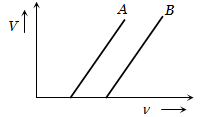
|
(a) Greater than that of B |
|
(b) Smaller than that of B |
|
(c) Equal to that of B |
|
(d) No inference can be drawn about their work functions from the given graphs |
Fraunhofer lines are obtained in
|
(a) Solar spectrum |
(b) The spectrum obtained from neon lamp |
|
(c) Spectrum from a discharge tube |
(d) None of the above |
For what value of unknown resistance X, the potential difference between B and D will be zero in the circuit shown in the figure

|
(a) 4 W |
(b) 6 W |
(c) 2 W |
(d) 5 W |
