Question
Get the electric field due to a uniformly charged infinite plane sheet.
Answer

Image
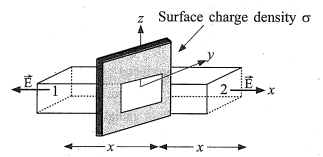
►Let $\sigma$ be the uniform surface charge density of an infinite plane sheet (Fig.). We take the $x$-axis normal to the given plane.
►By symmetry, the electric field will not depend on y and z coordinates and its direction at every point must be parallel to the x-direction.
►We can take the Gaussian surface to be a rectangular parallelpiped of cross-sectional area A, as shown. (A cylindrical surface will also do.)
►As seen from the figure, only the two faces 1 and 2 will contribute to the flux; electric field lines are parallel to the other faces and they, therefore, do not contribute to the total flux.
►Total flux passing through Gaussian surface.
$\begin{aligned}
\phi & =\text { Electric flux passing through Surface } 1 \\
& + \text { Electric flux passing through surface } 2 \\
\therefore \phi & =\text { EAcos } 0+\text { EA } \cos 0 \\
& =\text { EA }+ \text { EA } \\
& =2 EA
\end{aligned}$
►According to Gauss's law $=\phi=\frac{q}{\varepsilon_0}$
Thus, 2EA $=\frac{q}{\varepsilon_0}$
Where, $q=$ electric charge enclosed by
Gaussian surface
$\begin{aligned}
\quad q & =\text { Surface charge density } \times \text { Area } \\
\therefore \quad q & =\sigma A
\end{aligned}$
►Put the value in equation (3),
$\begin{array}{rlrl}
\therefore & 2 EA & =\frac{\sigma A }{\varepsilon_0} \\
\therefore & E & =\frac{\sigma}{2 \varepsilon_0} \\
2 EA & =\frac{\sigma A }{\varepsilon_0} \\
& \text { or, } & E & =\frac{\sigma}{2 \varepsilon_0}
\end{array}$
►Vectorically,
$\overrightarrow{ E }=\frac{\sigma}{2 \varepsilon_0} \hat{n}$
►Where $\hat{n}$ is a unit vector normal to the plane and going away from it, E is directed away from the plate if $\sigma$ is positive and toward the plate if $\sigma$ is negative.

Need a full question paper?

Generate a complete, print-ready paper with questions like this in minutes — across 16+ boards, with answer keys.
Start Generating Free

Similar questions

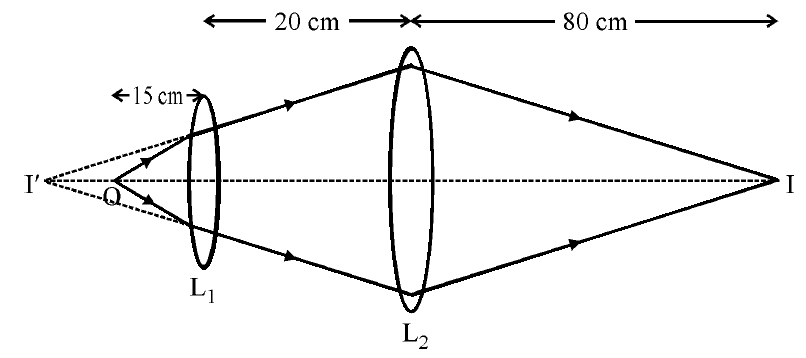
In the following diagram, an object ‘O’ is placed 15 cm in front of a convex lens L1 of focal length 20 cm and the final image is formed at ‘I’ at a distance of 80 cm from the second lens L2. Find the focal length of the lens L2.

A wire of length l carries a current i long the x-axis. A magnetic field exists, which is given $\overrightarrow{\text{B}}=\text{B}_0(\overrightarrow{\text{i}}+\overrightarrow{\text{j}}+\overrightarrow{\text{k}})\text{T}.$ Find the magnitude of the magnetic force acting on the wire.
i. Will the earth's magnetic field induce current in an artificial satellite with a metal surface that is in orbit around the equator? Around the poles?
ii. If so how would these currents affect the motion of the satellite?
The equation of a wave travelling on a string is:

$\text{y}=(0.10\text{mm})\sin\big[(31.4\text{m}^{-1})\text{x}+(314\text{s}^{-1})\text{t}\big].$

  1. In which direction does the wave travel?
  2. Find the wave speed, the wavelength and the frequency of the wave.
  3. What is the maximum displacement and the maximum speed of a portion of the string?
Prove that, if an insulated, uncharged conductor is placed near a charged conductor and no other conductors are present, the uncharged body must be intermediate in potential between that of the charged body and that of infinity.
A mobile phone is placed on the principal axis of a concave mirror. Show the formation of the image with a suitable ray diagram. Explain why the magnification is not uniform. Does the distortion of the image depend on the position of the phone relative to the mirror?
A certain material has refractive indices 1.56, 1.60 and 1.68 for red, yellow and violet light respectively.
  1. Calculate the dispersive power.
  2. Find the angular dispersion produced by a thin prism of angle 6° made of this material.
Two heating elements of resistances Rand Rwhen operated at a constant supply of voltage, V, Consume power P1 and P2  respectively. Deduce the expressions for the power of their combination when they are, in turn, connected in (i) series and (ii) parallel across the same voltage supply.
(II) (a) Define electric flux and write its SI unit.
(b) Use Gauss᾿s law to obtain the expression for the electric field due to a uniformly charged infinite plane sheet of charge.
A concave mirror has a focal length of 20cm. Find the position or positions of an object for which the imagesize is double of the object-size.