Question
Give a brief account of evolution of vertebrates.

Answer

→ About 2000 million years ago the first cellular life was found on earth.
→ About 350 million years ago, jawless fishes emerged.
→ Fish caught in South Africa in 1938, believed to be coelacanth, were thought to be extinct. → These animals evolved into known as lobefins, the first amphibians that could live on both land and water.
→ Although none of these specimens have survived to us, they were the ancestors of today's frogs and salamanders.
→ Reptiles descended from amphibians.They laid thick shelled eggs which did not dry out like amphibian eggs.
→ At the present time once again we can only see their descendants, tortoise, kashyapa and crocodile.
→ 200 million years or during which reptiles of different shapes and sizes dominated the earth.
→ Probably 200 million years ago evolved into reptiles like mastya and returned from land to water.
→ The land-dwelling reptiles were definitely dinosaurs.
→ The largest reptile Tyrannosaurus rex (T-rex) was 20 feet tall and had huge fearsome spear- like teeth.
→ About 65 million years ago, dinosaurs suddenly disappeared from the earth, which some believe to have been wiped out due to climatic changes.
→ Some even say that most of them may have evolved into birds.
→ But the truth is somewhere between these two. Because the small size reptiles of that time still exist.
→ Earlier mammals were like shrews.
Mammals were very intelligent in terms of sensitivity and overcoming fear.
→ When the reptiles decreased, the mammals took over the earth.
→ Mammals like horses, hippopotamus, bears, rabbits etc. were seen in South America.
→ Due to the continental drift, when North America joined South America, the animals of North America were scattered.
→ Due to similar continental drift, marsupials
survived in Australia because they did not have to compete with other mammals.
→ Some mammals live entirely in water. Whales, dolphins, seals and sea cows are some examples.
Need a full question paper?

Generate a complete, print-ready paper with questions like this in minutes — across 16+ boards, with answer keys.

Start Generating Free

Similar questions

Read the following and answer any four questions from (i) to (v) given below:

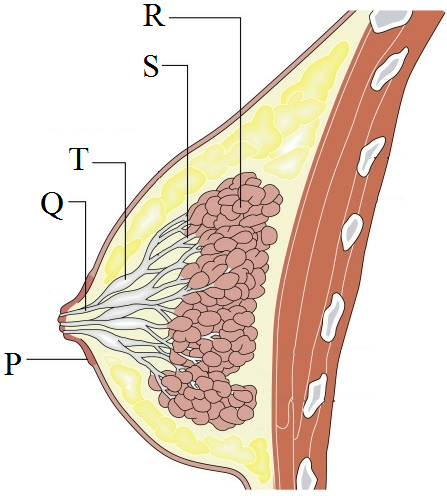
A functional mammary gland is characteristic of all female mammals. Mammary glands are paired structures that contain glandular tissue and variable amount of fat. Refer to the given figure of a mammary gland and answer the following questions.

  1. Mammary glands are modified:
  1. Sweat glands.
  2. Sebaceous glands.
  3. Sudoriferous glands.
  4. Lacrimal glands.
  1. Identify the incorrectly matched pair.
  1. P - Areola.
  2. Q - Lactiferous duct.
  3. S - Mammary duct.
  4. T - Mammary alveoli.
  1. Mammary ducts expand to form:
  1. Mammary alveoli.
  2. Mammary ampullae.
  3. Lactiferous ducts.
  4. Mammary tubules.
  1. What is areola?
  1. Grape-like clusters of milk secreting structures.
  2. Fatty tissue between the mammary lobes.
  3. Circular pigmented area of skin around nipple.
  4. Connective tissue that supports the alveoli and ducts.
  1. Assertion: The size of breast depends on the amount of adipose tissue.

Reason: The adipose tissue supports the alveoli and the ducts.

  1. Both assertion and reason are true, and reason is the correct explanation of assertion.
  2. Both assertion and reason are true, but reason is not the correct explanation of assertion.
  3. Assertion is true, but reason is false.
  4. Both assertion and reason are false.
Read the following text carefully and answer the questions that follow:
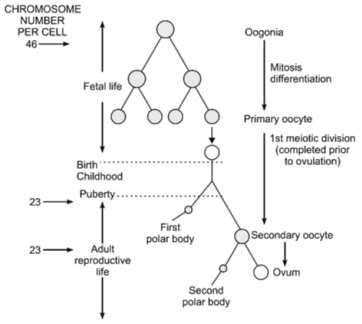
The process of formation of a mature female gamete is called oogenesis which is markedly different from spermatogenesis. A schematic representation of Oogenesis is shown below study the flow chart carefully.

Image
i. How is a primary oocyte different from a secondary oocyte? (1)
ii. Mention the changes taking place during the transition of a secondary follicle to Graafian follicle in the oogonia. (1)
iii. How many primary follicles are left in each ovary in a human female at puberty? (2)
OR
What happen to graafuan follicle after ovulation? (2)
Read the following and answer any four questions from (i) to (v) given below:

Oral administration of small doses of hormones is contraceptive method used by the females. They are used in the form of tablets and hence called the pills. The oral pills are two types; mini pills and combined pills.

  1. Mini pills contain:
  1. Estrogen only.
  2. Progestin only.
  3. Combination of progesterone-estrogen.
  4. Inhibin.
  1. How do hormonal pills prevent pregnancy?
  1. By phagocytosing the sperms.
  2. By inhibiting ovulation.
  3. By preventing sperms from entering the vagina.
  4. All of these.
  1. Pill containing non-steroidal preparation, centchroman is:
  1. Mala D.
  2. Mala N.
  3. I-Pill.
  4. Saheli.
  1. Which among the following is incorrect for oral contraceptives?
  1. Oral pills alter the uterine endometrium and make it unsuitable for implantation.
  2. Oral pills have to be taken daily for 7 days starting within first five days of menstrual cycle.
  3. Oral pills increase the risk of intravascular clotting.
  4. Oral pills contain either progestin alone or combination of progestogen and estrogen.
  1. Assertion: Mala D, a combined contraceptive pill, have to be taken daily without a break.

Reason: Mala D contains synthetic progesterone and estrogen.

  1. Both assertion and reason are true, and reason is the correct explanation of assertion.
  2. Both assertion and reason are true, but reason is not the correct explanation of assertion.
  3. Assertion is true, but reason is false.
  4. Both assertion and reason are false.
Explain the amplification of gene of interest using PCR (Diagram is must)
Read the following and answer any four questions from (i) to (v) given below:

Deoxyribonucleic acid (DNA) and ribonucleic acid (RNA) are the two types of nucleic acids found in the living systems. DNA acts as the genetic material in most of the organisms. Although, RNA also acts as a genetic material in some organisms.

  1. In which of the following organisms, RNA acts as a genetic material?
  1. Escherichia coli
  2. $\text{Q}\beta$ Bacteriophage
  3. Tobacco Mosaic viruses
  4. Both (b) and (c)
  1. What is the reason for the additional stability of DNA in comparison to RNA?
  1. Presence of thymine
  2. Presence of uracil
  3. Presence of OH group
  4. Presence of deoxyribose sugar
  1. Which of the following criteria a molecule must fulfill to act as a genetic material?
  1. It should be able to generate its replica.
  2. It should be stable chemically and structurally.
  3. It should be able to express itself in the form of Mendelian character.
  4. All of these
  1. Assertion: RNA is liable and easily degradable.

Reason: The 2'- OH group present at every nucleotide in RNA is a reactive group

  1. Both assertion and reason are true, and reason is the correct explanation of assertion.
  2. Both assertion and reason are true, but reason is not the correct explanation of assertion.
  3. Assertion is true, but reason is false.
  4. Both assertion and reason are false.
  1. Read the given statement and select the option that correctly fill in the blanks. Pyrimidines present in DNA are (i) and (ii) while pyrimidines present in RNA are (iii) and (iv).
  1. (i)-Adenine (iii)-Guanine (iii)-Cytosine, (iv)-Thymine
  2. (i)-Cytosine (iii)Thymine (iii)-Cytosine, (iv)-Uracil
  3. (i)-Cytosine (iii)-Uracil (iii)-Adenine, (iv)-Guanine
  4. (i)-Cytosine (iii)-Uracil (iii)-Cytosine, (iv)-Thymine
Read the following and answer any four questions from (i) to (v) given below:

Discovery of penicillin by Alexander Fleming in 1928 marked the beginning of the remarkable era in medical field. Penicillin was the first antibiotic extracted from Penicillium notatum. Antibiotics are used to treat bacterial diseases. These can be broad spectrum which can kill diverse group of disease causing bacteria and narrow spectrum which is effective only against one group of pathogenic strain. Antibiotics can act as bactericides or bacteriostatic. Bactericidal antibiotics kill bacteria by - disruption of cell wall synthesis (e.g., penicillin, cephalosporin, etc.), inhibition of SOS ribosome function (e.g.; erythromycin), inhibition of 30S ribosome function (e.g., streptomycin, neomycin), inhibition of amino acid-tRNA binding to ribosome (e.g., tetracyline). etc. Bacteriostatic antibiotics do not kill the bacteria rather they restrict the growth of bacteria. Penicillin belongs to $\beta$-lactum group of antibiotics and it inhibits bacterial cell wall synthesis by binding and inactivating protein. It inhibits transpeptidation of reaction and blocks cross-linking of the cell wall. It is used to treat tonsilitis, sore throat, gonorrhoea, rheumatic fever and some pneumonia types.

  1. The first antibiotic was extracted from a:
  1. Lichen.
  2. Fungus.
  3. Eubacteria.
  4. Acti-nomycetes.
  1. Which of the following kills bacteria by interfering SOS ribosome function?
  1. Cephalosporin.
  2. Erythromycin.
  3. Streptomycin.
  4. Neomycin.
  1. $\beta$-lactum group of antibiotics kill the bacterial pathogen by:
  1. Disruption of plasma membrane.
  2. Inhibition of translation of mRNA.
  3. Inhibition of translation of mRNA
  4. Inhibition of transcription of mRNA.
  1. Penicillin is not used to treat.
  1. Pneumonia.
  2. Tonsilitis.
  3. Rheumatic fever.
  4. Candidiasis.
  1. Assertion: Cephalosporins act by disruption of bacterial cell wall synthesis mechanism.

Reason: Cephalosporins are bacteriostatic antibiotics.

  1. Both assertion and reason are true and reason is the correct explanation of assertion.
  2. Both assertion and reason are true but reason is not the correct explanation of assertion.
  3. Assertion is true but reason is false.
  4. Both assertion and reason are false.
Read the following text carefully and answer the questions that follow:
The pathogen of a disease depends on RBCs of human for growth and reproduction. The person with this
pathogen suffers with chill and high fever.
Image
i. Identify the disease. (1)
ii. Name the pathogen. (1)
iii. What is the cause of fever? (2)
OR
Represent the life cycle of the pathogen diagrammatically. (2)
Highlight five areas where biotechnology has influenced our lives.
Read the following text carefully and answer the questions that follow:
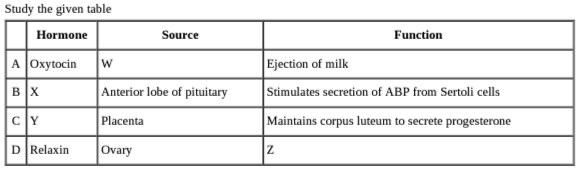
Image
i. Identify the hormones X and Y respectively. (1)
ii. Label W and Z. (1)
iii. Name the hormones produced only during pregnancy in human female. Mention their source organs. (2)
OR
Name any two hormones which are secreted by placenta and are also present in a non-pregnant woman. (2)
Read the following and answer any four questions from (i) to (v) given below:

Medical termination of pregnancy is termination of pregnancy before the fetus become viable. To reduce the incidence of illegal abortion and consequent maternal mortality, MTP Amendment Act, 2017 was enacted by the government of India. About 40-50 million MTPs are done in a year all over the world.

  1. Abortion can be safely done for about ______ weeks of pregnancy.
  1. 4
  2. 12
  3. 8-10
  4. 15-18
  1. How is MTP helpful in decreasing human population?
  1. By aborting normal female fetus.
  2. By aborting normal female fetus.
  3. By getting rid of unwanted pregnancies.
  4. None of these.
  1. Select an incorrect statement for MTP.
  1. Second trimester abortions are more risky than first trimester.
  2. It is being misused to abort normal female fetus.
  3. It helps to get rid of unwanted pregnancies.
  4. Child detected with congenital heart disease cannot be aborted.
  1. MTP was legalised by Government of India in:
  1. 1971
  2. 1982
  3. 1973
  4. 1991
  1. Assertion: MTPs are safe during first trimester of pregnancy.

Reason: After first trimester, fetus become intimately associated with the maternal tissues.

  1. Both assertion and reason are true, and reason is the correct explanation of assertion.
  2. Both assertion and reason are true, but reason is not the correct explanation of assertion.
  3. Assertion is true, but reason is false.
  4. Both assertion and reason are false.