Question
Give an example for which $\overrightarrow{\text{A}}.\overrightarrow{\text{B}}=\overrightarrow{\text{C}}.\overrightarrow{\text{B}}$ but $\overrightarrow{\text{A}}\neq\overrightarrow{\text{C}}.$

Answer

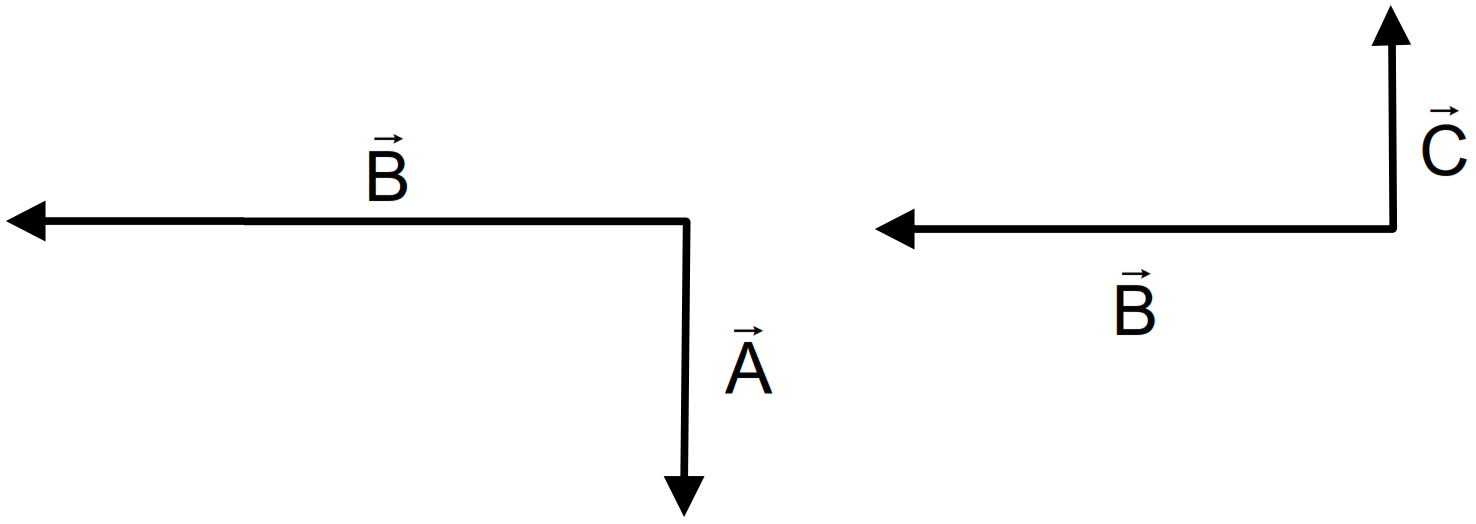
For example, as shown in the figure,

$\overrightarrow{\text{A}}\perp\overrightarrow{\text{B}}:\overrightarrow{\text{B}} \ \text{along west}$ 

$\overrightarrow{\text{B}}\perp\overrightarrow{\text{C}}:\overrightarrow{\text{A}}\text{ along south}$ 

$\overrightarrow{\text{C}} \text{along north}$

$\overrightarrow{\text{A}}.\overrightarrow{\text{B}}=0$ $\therefore\overrightarrow{\text{A}}.\overrightarrow{\text{B}}=\overrightarrow{\text{B}}.\overrightarrow{\text{C}}$

$\overrightarrow{\text{B}}.\overrightarrow{\text{C}}=0$ But $\overrightarrow{\text{B}}\neq\overrightarrow{\text{C}}$
Need a full question paper?

Generate a complete, print-ready paper with questions like this in minutes — across 16+ boards, with answer keys.
Start Generating Free

Similar questions

Can the voltage drop across the inductor or the capacitor in a series LCR circuit be greater than the applied voltage of the a.c. source? Justify your answer.
A free neutron beta-decays to a proton with a half-life of 14 minutes.
  1. What is the decay constant?
  2. Find the energy liberated in the process.
A voltmeter consists of a $25\Omega$ coil connected in series with a $575\Omega$ resistor. The coil takes 10mA for full scale deflection. What maximum potential difference can be measured by this voltmeter?
The field lines of a positive point charge are shown in below figure.
Image
(a) Give the sign of the potential difference $V_P-V_Q$
(b) Give the sign of the work done by the field in moving a small positive charge from Q to P.
(c) Give the sign of the potential energy difference of a small negative charge between the points Q to P.
Explain why current is not formed in solid conductors in the absence of electric field.
Derive/obtain the instantaneous power and average power for an AC circuit having purely inductive component.
Two bar magnets are placed close to each other with their opposite poles facing each other. In absence of other force the magnets are pulled towards each other and their kinetic energy increases. Does it contradict our earher knowledge that magnetic forces cannot do any work and hence cannot increase kinetic energy of a system?
The masses of 11C and 11B are respectively 11.0114u and 11.0093u. Find the maximum energy a positron can have in the $\beta^+$-decay of 11C to 11B.
In which situation is there a displacement current, but no conduction current?
Balmer series was observed and analysed before the other series. Can you suggest a reason for such an order?