Question
Give an explanation about electric field lines and explain how they can be drawn.

Answer

Image
►Electric field lines are the pictorial representation of an electric field.
►Electric field lines were first described by a scientist named Michael Faraday.
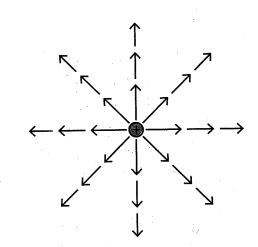
►Let the point charge be placed at the origin. Draw vectors pointing along the direction of the electric field with their lengths proportional to the strength of the field at each point.
►Since the magnitude of electric field at a point decreases inversely as the square of the distance of that point from the charge from $\left( E =\frac{k Q }{r^2}\right)$ the vector gets shorter as one goes away from the origin, always pointing radially outward. Figure shows such a picture.
►In this figure, each arrow indicates the electric field, i.e., the force acting on a unit positive charge, placed at the tail of that arrow.
►Connect the arrows pointing in one direction and the resulting figure represents a field line. We thus get many field lines, all pointing outwards from the point charge.
►The magnitude of the field is represented by the density of field lines. E is strong near the charge, so the density of field lines is more near the charge and the lines are closer.
►Away from the charge, the field gets weaker and the density of field lines is less, resulting in well-separated lines.

Need a full question paper?

Generate a complete, print-ready paper with questions like this in minutes — across 16+ boards, with answer keys.

Start Generating Free

Similar questions

A point charge ‘q’ is placed at O as shown in the figure.

Is $V_P — V_Q$ positive or negative when (i) q > 0, (ii) q < 0? Justify your answer.
Two bar magnets are placed close to each other with their opposite poles facing each other. In absence of other force the magnets are pulled towards each other and their kinetic energy increases. Does it contradict our earher knowledge that magnetic forces cannot do any work and hence cannot increase kinetic energy of a system?
Write briefly the underlying principle used in Davison-Germer experiment to verify wave nature of electrons experimentally. What is the de-Broglie wavelength of an electron with kinetic energy (of).120 ev? Write briefly the underlying principle used in Davison-Germer experiment to verify wave nature of electrons experimentally. What is the de-Broglie wavelength of an electron with kinetic energy (of).120 ev?
A positive charge q is placed in front of a conducting solid cube at a distance d from its centre. Find the electric field at the centre of the cube due to the charges appearing on its surface.
On what does the work function of a metal depend?
A bullet passes past a person at a speed of 220m/s. Find the fractional change in the frequency of the whistling sound heard by the person as the bullet crosses the person. Speed of sound in air = 330m/s.
In a Van de Graaff type generator a spherical metal shell is to be a $15 \times 10^6 \mathrm{~V}$ electrode. The dielectric strength of the gas surrounding the electrode is $5 \times 10^7 \mathrm{Vm}^{-1}$. What is the minimum radius of the spherical shell required? (You will learn from this exercise why one cannot build an electrostatic generator using a very small shell which requires a small charge to acquire a high potential.)
Can a metallic sphere of radius 1 cm acquire a charge of 1 Coulomb?
A deuteron and an alpha particle having same momentum are in turn allowed to pass through a magnetic field $\vec{B}$, acting normal to the direction of motion of the particles. Calculate the ratio of the radii of the circular paths described by them.
The potential difference between the terminals of a 6.0V battery is 7.2V when it is being charged by a current of 2.0A. What is the internal resistance of the battery?