Question
Give any three differences between progressive waves and stationary waves. A stationary wave is $\text{y}=12\sin300\text{t}\cos^2\text{x}.$ What is the distance between two nearest nodes?

Answer

S. No.
Progressive Wave
Stationary Wave
1.
All particles have same phase and amplitude.
Amplitude varies with position.
2.
Speed of motion is same.
Speed varies with position.
3.
Energy is transported.
Energy is not transported.
4.
Same change in pressure and density is with every point.
Pressure and density varies with point.

$\text{y}=12\sin300\text{t}\cos2\text{x}$

Comparing with equation of stationary wave

$\text{y}=2\text{A}\sin\omega\text{t}\cos\text{kx}$

$\text{k}=2$

Distance between two consecutive nodes $=\frac{\lambda}{2}$ Where $\lambda$ is wavelength

$\text{k}=\frac{2\pi}{\lambda}$

$\Rightarrow\frac{\pi}{\Big(\frac{\lambda}{2}\Big)}=2$

$\therefore \frac{\lambda}{2}=\frac{\pi}{2}$

So, the distance between two nearest nodes is $\frac{\pi}{2}.$

Need a full question paper?

Generate a complete, print-ready paper with questions like this in minutes — across 16+ boards, with answer keys.
Start Generating Free

Similar questions

Two vessels A and B of equal volume V0 are connected by a narrow tube that can be closed by a valve. The vessels are fitted with pistons that can be moved to change the volumes. Initially, the valve is open and the vessels contain an ideal gas $\Big(\frac{\text{C}_\text{P}}{\text{C}_\text{V}}=\gamma\Big)$ at atmospheric pressure p0 and atmospheric temperature T0. The walls of vessel A are diathermic and those of B are adiabatic. The valve is now closed and the pistons are slowly pulled out to increase the volumes of the vessels to double the original value.
  1. Find the temperatures and pressures in the two vessels.
  2. The valve is now opened for sufficient time so that the gases acquire a common temperature and pressure. Find the new values of the temperature and pressure.
If the nucleons of a nucleus are separated from each other, the total mass is increased. Where does this mass come from?
A paperweight in the form of a hemisphere of radius 3.0cm is used to hold down a printed page. An observer looks at the page vertically through the paperweight. At what height above the page will the printed letters near the centre appear to the observer?
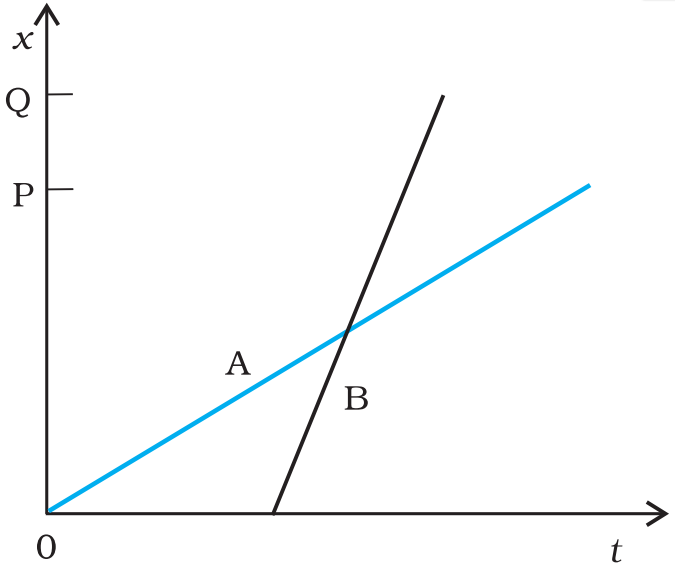
The position-time (x-t) graphs for two children A and B returning from their school O to their homes P and Q respectively are shown in Choose the correct entries in the brackets below;

  1. (A/B) lives closer to the school than (B/A).
  2. (A/B) starts from the school earlier than (B/A).
  3. (A/B) walks faster than (B/A).
  4. A and B reach home at the (same/different) time.
  5. (A/B) overtakes (B/A) on the road (once/twice).

A source of sound operates at 2.0kHz, 20W emitting sound uniformly in all directions. The speed of sound in air is 340m/s and the density of air is 1.2kg/m3.
  1. What is the intensity at a distance of 6.0m from the source?
  2. What will be the pressure amplitude at this point?
  3. What will be the displacement amplitude at this point ?
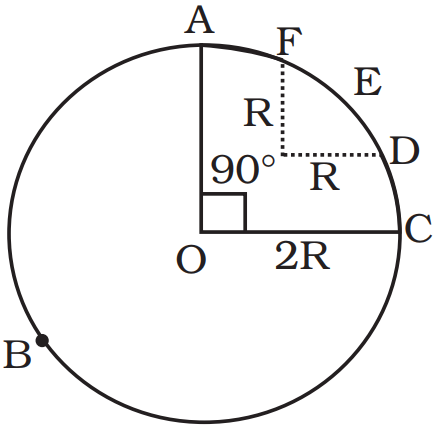
A racing car travels on a track (without banking) ABCDEFA ABC is a circular arc of radius 2 R. CD and FA are straight paths of length R and DEF is a circular arc of radius R = 100 m. The co-effecient of friction on the road is $\mu = 0.1.$ The maximum speed of the car is 50m s–1. Find the minimum time for completing one round.

A rocket is fired from the earth towards the sun. At what distance from the earth's centre is the gravitational force on the rocket zero? Mass of the sun $=2 \times 10^{30} kg$, mass of the earth $=6 \times 10^{24} kg$. Neglect the effect of other planets etc. (orbital radius $\left.=1.5 \times 10^{11} m\right)$.
A uniform rod of mass m and length l is struck at an end by a force F perpendicular to the rod for a short time interval t. Calculate:
  1. The speed of the centre of mass.
  2. The angular speed of the rod about the centre of mass.
  3. The kinetic energy of the rod.
  4. The angular momentum of the rod about the centre of mass after the force has stopped to act. Assume that t is so small that the rod does not appreciably change its direction while the force acts.
Consider the following very rough model of a beryllium atom. The nucleus has four protons and four neutrons confined to a small volume of radius 10-15m. The two 1s electrons make a spherical charge cloud at an average distance of 1.3 × 10⁻¹¹m from the nucleus, whereas the two 2s electrons make another spherical cloud at an average distance of 5.2 × 10⁻¹¹m from the nucleus. Find the electric field at:
  1. A point just inside the 1s cloud.
  2. A point just inside the 2s cloud.
A hot body placed in a surrounding of temperature $\theta_0$ obeys Newton's law of cooling $\frac{\text{d}\theta}{\text{dt}}=-\text{k}(\theta-\theta_0).$ Its temperature at t = 0 is $\theta_1.$ The specific heat capacity of the body is s and its mass is m. Find,
  1. The maximum heat that the body can lose.
  2. The time starting from t = 0 in which it will lose 90% of this maximum heat.