Question
Give any two examples of turgor movements in plants.

Answer

(i) Turgor pressure helps the plants to push through the hard ground as in mushrooms and in a seedling.
(ii) Sometimes, the roots of certain trees crack the walls or a concrete floor of an adjoining building. This happens due to the turgor pressure.

Need a full question paper?

Generate a complete, print-ready paper with questions like this in minutes — across 16+ boards, with answer keys.
Start Generating Free

Similar questions

(i) What is a lacrimal gland?
(ii) In what two ways is yellow spot different from blind spot?
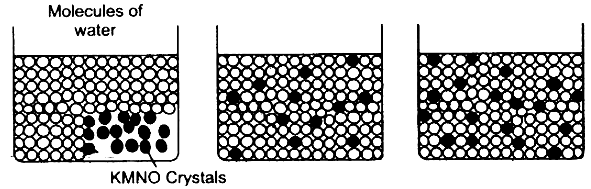
Given below is an experimental demonstration.

(i) Which phenomenon has been demonstrated in the given figure?
(ii) What is the solute and what is solvent in the above experiment?
(iii) Define the phenomenon in Q. (i) above.
(iv) Give one example from your daily life experiences based on this principle.
Differentiate
Urinogenital system and Urinary system.
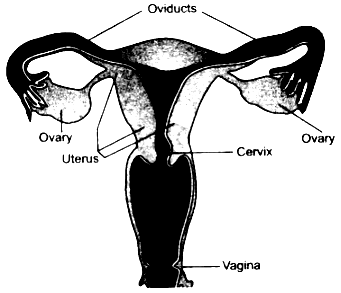
The adjoining figure represents the female reproductive organ of the humans

(i) How does the human embryo developing in the uterus obtain its nourishment?
(ii) Which structure protects and nourishes the developing embryo?
(iii) Define ovulation.
Explain natality.
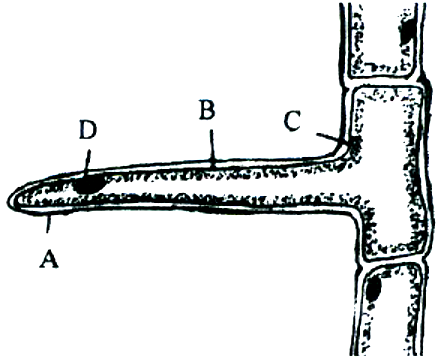
The diagram below represents a layer of epidermal cells showing a fully grown root hair. Study the diagram and answer the questions that follow:
Mention one distinct difference between the parts labelled A and B.
Differentiate between the following pairs of term :
Excretion and katabolism
What do you understand by population explosion? Discuss its consequences.
A potted plant was taken in order to prove a factor necessary for photosynthesis. The potted plant was kept in the dark for 24 hours. One of the leaves was covered with black paper in the centre. The potted plant was then placed in sunlight for a few hours.
Write a balanced chemical equation to represent the process of photosynthesis.
Differentiate between members of the following pairs with reference to the aspect asked within bracket:
Artery and vein (direction of blood flow)