Question
Give brief information about the solenoid.

Answer

Solenoid : "A helical coil consisting of closely wound turns of insulated conducting wire is called a solenoid."
→If the length of a solenoid is very large as compared to its radius, the solenoid is called long solenoid.
→Solenoid consists of a long wire wound in the form of a helix where the turns are closely spaced. Hence, each turn can be considered as a circular loop.
→The total magnetic field of solenoid is the vector sum of the fields due to all the turns.
→Enamelled wires are used for winding to make turns insulated from each other.
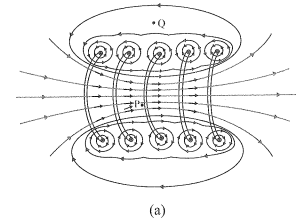
Image

(a) The magnetic field due to a section of the solenoid which has been stretched out for clarity. Only the exterior semicircular part is shown. Notice how the circular loops between neighbouring turns tend to cancel.
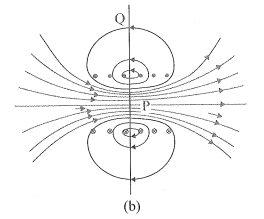
Image

(b) The magnetic field of a finite solenoid.
→Figure shows the magnetic field lines for a finite solenoid.
→It is clear from the figure (a) that the magnetic field of the circular loop between two neighbouring turns cancel out each other (in opposite direction)
→From the figure (b), it can be seen that the magnetic field is uniform, strong and in the direction of its axis at the mid point P inside the solenoid.
→While the magnetic field at the outer mid point Q is weak and almost parallel to the axis of the solenoid.
→ As the solenoid is made longer it looks like a long cylindrical metal sheet.
→Here we assume that for a long solenoid, the magnetic field outside the solenoid is zero, while inside the magnetic field is parallel to the axis every where.

Need a full question paper?

Generate a complete, print-ready paper with questions like this in minutes — across 16+ boards, with answer keys.

Start Generating Free

Similar questions

The battery discussed in the previous question is suddenly disconnected. Is a current induced in the other loop? If yes, when does it start and when does it end? Do the loops attract each other or repel?
In Ampere's $\oint\overrightarrow{\text{B}}.\text{d}\overrightarrow{\text{l}}=\mu_0\text{i},$ the current outside the curve is not included on the right hand side. Does it mean that the magnetic field B calculated by using Ampere's law, gives the contribution of only the currents crossing the area bounded by the curve?
An extended object is placed at a distance of 5.0cm from a convex lens of focal length 8.0cm.
  1. Draw the ray diagram (to the scale) to locate the image and from this, measure the distance of the image from the lens.
  2. Find the position of the image from the lens formula and see how close the drawing is to the correct result.
The internal resistance of an accumulator battery of emf 6V is $10\Omega$ when it is fully discharged. As the battery gets charged up, its internal resistance decreases to $1\Omega.$
The battery in its completely discharged state is connected to a charger that maintains a constant potential difference of 9V. Find the current through the battery (a) just after the connections are made and (b) after a long time when it is completely charged.
As temperature increases, the viscosity of liquids decreases considerably. Will this decrease the resistance of an electrolyte as the temperature increases?
Two cells of emf 10V and 2V and internal resistance $10\Omega$ and $5\Omega$ respectively, are connected in parallel as shown. Find the effective voltage across R. 
A convex lens of diameter 8.0cm is used to focus a parallel beam of light of wavelength 620nm. If the light be focused at a distance of 20cm from the lens, what would be the radius of the central bright spot formed?
Which of the following electromagnetic waves has (a) minimum wavelength, and (b) minimum frequency? Write one use of each of these two waves.
Infrared waves, Microwaves, $\gamma$-rays and X-rays
Calculate the bulk modulus of air from the following data about a sound wave of wavelength $35\ cm$ travelling in air. The pressure at a point varies between $(1.0\times10^5\pm14)$ Pa and the particles of the air vibrate in simple harmonic motion of amplitude $5.5 \times 10^{-6}m.$
Calculate the radius of curvature of an equi$-$concave lens of refractive index $1.5,$ when it is kept in a medium of refractive index $1.4,$ to have a power of $-5D?$