Question
Give condensed and bond line structural formulas and identify the functional group(s) present, if any, for:
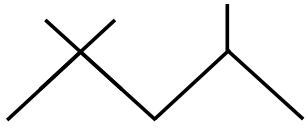
  1. 2, 2, 4-Trimethylpentane.
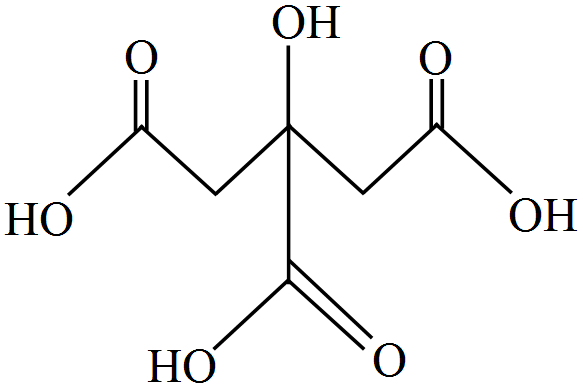
  2. 2-Hydroxy-1, 2, 3-propanetricarboxylic acid.
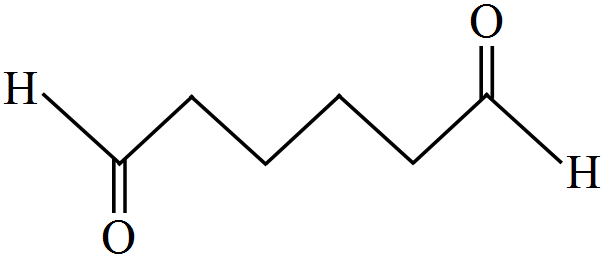
  3. Hexanedial.

Answer

 
Molecular formula
Bond live structure
Condensed structure
Functional groups
(a)
2, 2, 4-Trimethyl pentane
(CH3)3CCH2CH(CH3)2
-
(b)
2-Hydroxy-1, 2, 3,-propanetri-carboxylic acid
HOOCCH2C(OH)(COOH)CH2COOH


-OH(hydroxyl)
-COOH (Carboxyl) group
(c)
Hexanedial
OHC(CH2)4CHO
-CHO aldehyde group

Need a full question paper?

Generate a complete, print-ready paper with questions like this in minutes — across 16+ boards, with answer keys.

Start Generating Free

Similar questions

What is the valence shell electron pair repulsion principle? Explain how this determines the geometry of molecules.
Match the species in Column I with the type of hybrid orbitals in Column II.
 
Column I
 
Column II
i.
SF4
a.
sp3d2
ii.
IF5
b.
d2sp
iii.
$\text{NO}^{+}_{2}$
c.
sp3d
iv.
$\text{NH}^{+}_{4}$
d.
sp3
 
 
e.
Sp
Explain the Liebig's combustion process for analysis of carbon and hydrogen.
The longest wavelength doublet absorption transition is observed at 589 and 589.6nm. Calcualte the frequency of each transition and energy difference between two excited states.
Nitric oxide reacts with Br2 and gives nitrosyl bromide as per reaction given below:
$2\text{NO (g) + Br}_2\text{ (g)}\leftrightharpoons2\text{NOBr (g)}$
When 0.087mol of NO and 0.0437mol of Br2 are mixed in a closed container at constant temperature, 0.0518mol of NOBr is obtained at equilibrium. Calculate equilibrium amount of NO and Br2.
Classify the following species into Lewis acids and Lewis bases and show how these act as Lewis acid/base:
  1. OH
  2. F
  3. H+
  4. BCl3
The ionization constant of acetic acid is 1.74 × 10⁻⁵. Calculate the degree of dissociation of acetic acid in its 0.05M solution. Calculate the concentration of acetate ion in the solution and its pH.
How would you explain the fact that the first ionization enthalpy of sodium is lower than that of magnesium but its second ionization enthalpy is higher than that of magnesium?
Explain various methods of formation of alkynes.
Product the sign $\Delta\text{S}$ for the following changes:
  1. Freezing of water.
  2. C(graphite) → C(diamond).
  3. H2(g) at 298 K and 1 bar → H2(g) at 298 K and 10 bar.
  4. H2(g) +I2(g) → 2HI(g).
  5. 2NaHCO3(s) → Na2CO3(s) + CO2(g) + H2O(g).