Question
Give differences between cartilaginous and bony fishes.

Answer

Differences between cartilaginous and bony fishes:
S.No.
Cartilaginous Fishes (Chondrichthyes)
Bony Fishes (Osteichthyes)
1.
They are always marine.
They may be marine or freshwater.
2.
Skin is covered by small placoid scales.
Skin is covered with large cycloid scales.
3.
Endoskeleton is cartilaginous.
Endoskeleton is partly or completely bony.
4.
Gill slits are not covered by gill covers.
Gill slits are covered by gill covers.
5.
Swim bladder is absent.
Swim bladder is present.
6.
Tail fin is asymmetrical .
Tail fin is symmetrical.
7.
Excretory matter is urea.
Excretory matter is ammonia.
8.
They exhibit sexual dimorphism.
Sexual dimorphism is usually present.
9.
Mostly viviparous
Usually oviparous.
10.
e.g., sharks, skates.
e.g., Labeo, Catle, Hilsa.

Need a full question paper?

Generate a complete, print-ready paper with questions like this in minutes — across 16+ boards, with answer keys.
Start Generating Free

Similar questions

Mention the difference between hypothyroidism and hyperthyroidism.
What is the role played by renin-angiotensin in the regulation of kidney function?
Describe cilia and flagella of eukaryotic cell. How are flagella of eukaryotes different from those of prokaryotic cell?
Draw a labelled diagram of the reproductive organs of an earthworm.
What is a semi-technical description of a flowering plant?
Raman's father while teaching him for his unit tests explained him that growth is regarded as the most fundamental and conspicuous characteristic of all living beings, but a piece of wood, when placed in water also increases in diameter. Raman got little confused about the growth process in plants.
  1. What is growth?
  2. Why do plants grow throughout their life? What term is given to this form of growth?
  3. Is plant growth measurable? State the parameters of growth measurement in plants.
  4. What value do you learn from the character of Raman's father?
What is meant by coelenterata? Write the main characteristics of Coelenterata and make a labelled diagram of Aurelia and Adamsia.
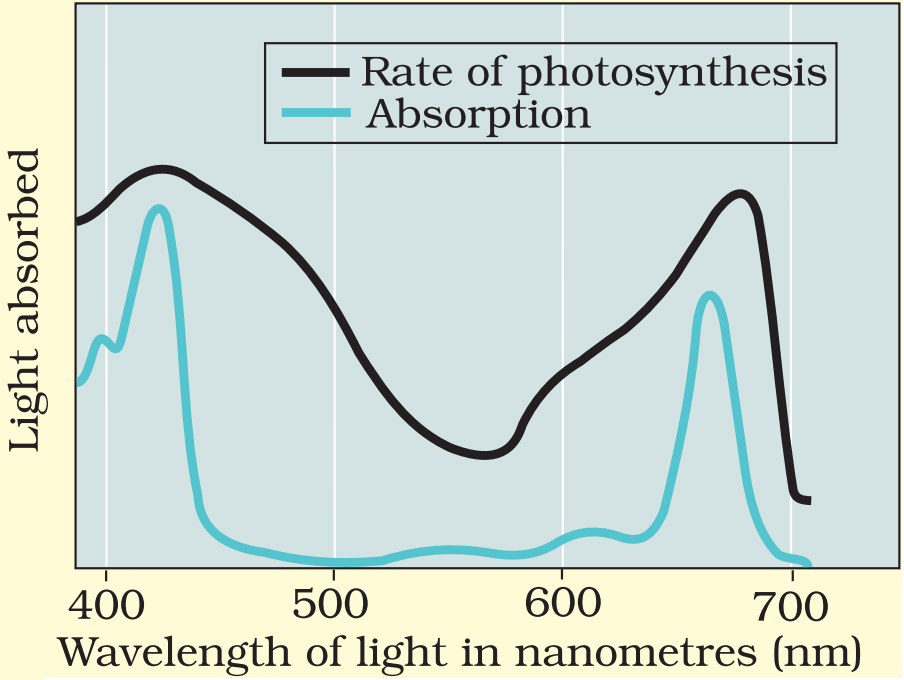
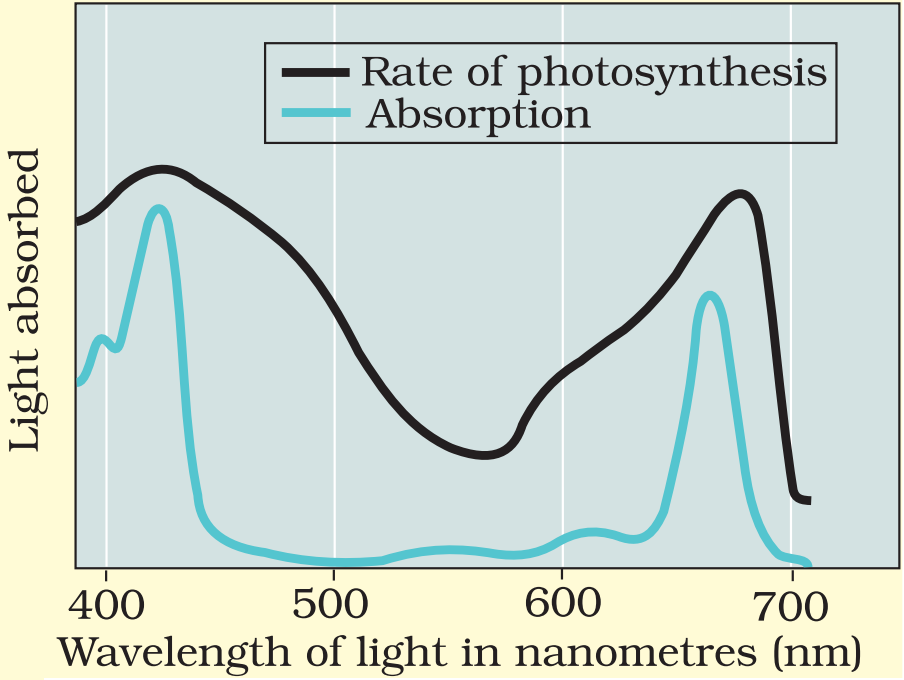
In the figure given below, the black line (upper) indicates action spectrum for photosynthesis and the lighter line (lower) indicates the absorption spectrum of chlorophyll a, answer the following:
  1. What does the action spectrum indicate? How can we plot an action spectrum? Explain with an example.
  2. How can we derive an absorption spectrum for any substance?
  3. If chlorophyll a is responsible for light reaction of photosynthesis, why do the action spectrum and absorption spectrum not overlap?
How have the terrestrial organisms adapted themselves for conservation of water?
Amit went on mountain for trekking. After reaching at about 2000 m height. He experienced difficulty in breathing. His rate of breathing increased and he decided to discontinue the trek and return back to the ground. Being concerned about his health. ls consulted his doctor friend about it? His friend explained that it is a normal phenomenon and he should have carried an oxygen cylinder while going for the trek.
  1. Why is it difficult to breathe as we go up on a height?
  2. Why does his friend suggested to carry an oxygen cylinder?
  3. Which component of blood show its increase when someone moves from plains to higher altitudes?
  4. What values are shown by Amit?