Question
Give explanation about wave front.
###
Explain Wave front.

Answer

When we drop a small stone on a calm pool of water, waves spread out from the point of impact. Every point on the surface starts oscillating with time.
At any instant the photograph of the surface would show circular rings, on which the disturbance is maximum. Clearly, all points on such a circle are oscillating in phase, because they are at the same distance from the source.
Such a locus of points, which oscillate in phase is called a wave front.
Thus, a wave front is defined as a surface of constant phase.
[In other words, "an imaginary surface passing through all the points oscillating in phase is called a wave front."
The speed with which the wave front moves outwards from the source is called the speed of the wave. The energy of the wave travels in a direction perpendicular to the wave front.
Image
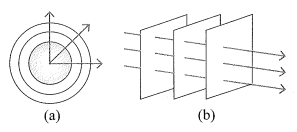
If we have a point source emitting waves uniformly in all directions, then the locus of points which have the same amplitude and vibrate in the same phase are spheres, and we will have what is known as a spherical wave as shown in fig. (a).
At a large distance from the source, a small portion of the sphere can be considered as a plane, and we will have what is known as a plane wave. [fig.(b)]

Need a full question paper?

Generate a complete, print-ready paper with questions like this in minutes — across 16+ boards, with answer keys.

Start Generating Free

Similar questions

The work function for the following metals is given:
Na: 2.75 eV; K: 2.30 eV; Mo: 4.17 eV; Ni: 5.15 eV. Which of these metals will not give photoelectric emission for a radiation of wavelength 3300 Å from a He-Cd laser placed 1 m away from the photocell? What happens if the laser is brought nearer and placed 50 cm away?
What is the energy of a hydrogen atom in the first excited state if the potential energy is taken to be zero in the ground state?
Suppose, one wishes to construct a 1.0 farad capacitor using circular discs. If the separation between the discs be kept at 1.0mm, what would be the radius of the discs?
A parallel plate capacitor is charged by a battery. After some time the battery is disconnected and a dielectric slab of dielectric constant K is inserted between the plates. How would (i) the capacitance, (ii) the electric field between the plates and (iii) the energy stored in the capacitor, be affected? Justify your answer.
Radiation from hydrogen discharge tube falls on a cesium plate. Find the maximum possible kinetic energy of the photoelectrons. Work function of cesium is 1.9eV.
Two prisms of identical geometrical shape are combined with their refracting angles oppositely directed. The materials of the prisms have refractive indices 1.52 and 1.62 for violet light. A violet ray is deviated by 1.0° when passes symmetrically through this combination. What is the angle of the prisms?
Does focal length of a lens depend on the colour of the light used? Does focal length of a mirror depend on the colour?
An object is placed at (i) $10 cm$, (ii) $5 cm$ in front of a concave mirror of radius of curvature $15 cm$. Find the position, nature, and magnification of the image in each case.
A convex lens of focal length 20 cm is placed coaxially with a convex mirror of radius of curvature 20 cm. The two are kept 15 cm apart. A point object is placed 40 cm in front of the convex lens. Find the position of the image formed by this combination. Draw the ray diagram showing the image formation.
Consider a 10cm long piece of a wire which carries a current of 10A. Find the magnitude of the magnetic field due to the piece at a point which makes an equilateral triangle with the ends of the piece.