Question
Give five example each of animals which develop:
$1.$ Inside the mother.
$2.$ Inside eggs which the mother lays.

Answer

$1.$ The animals which give birth to young one are called viviparous animals. In such animals, the baby develops inside the body of the mother.
Examples of Viviparous animals: Human beings, cat, dog, cow, tiger.
$2.$ The animals that reproduce by laying eggs are called oviparous animals. In such animals, the baby develops inside eggs that the mother lays.
Examples of Oviparous animals: Frog, sparrow, lizard, hen, fish, butterfly.

Need a full question paper?

Generate a complete, print-ready paper with questions like this in minutes — across 16+ boards, with answer keys.

Start Generating Free

Similar questions

Paddy is a major cereal crop in our country. What measures must be taken to prevent spoilage and insect attack of harvested grains.
Draw a neat and labelled diagram of the human ear. Explain its working.
Explain why school bags are provided with wide straps to carry them.
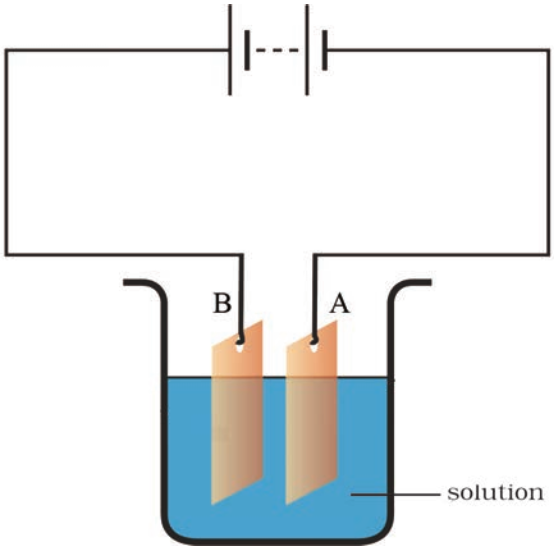
Observe the circuit given in Figure.

Boojho set up this circuit for purification of copper. What will be the nature of:
$i.$ Plate $A$.
$ii.$ Plate $B$.
$iii.$ The solution.
Explain the process of purification.
Aanandi took two test tubes and marked them A and B. She put two spoonfuls of sugar solution in each of the test tubes. In test tube B, she added a spoonful of yeast. Then she attached two incompletely inflated balloons to the mouth of each test tube. She kept the setup in a warm place, away from sunlight.
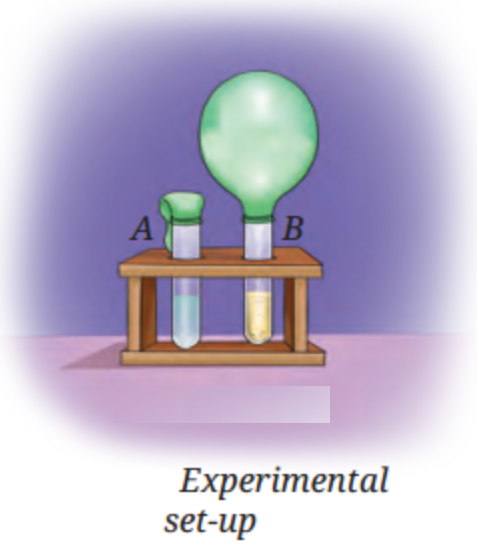
Image
(i) What do you predict will happen after 3-4 days? She observed that the balloon attached to test tube B was inflated. What can be a possible explanation for this?
(a) Water evaporated in test tube B and filled the balloon with the water vapour.
(b) The warm atmosphere expanded the air inside test tube B, which inflated the balloon.
(c) Yeast produced a gas inside test tube B, which inflated the balloon.
(d) Sugar reacted with warm air, which produced gas, eventually inflating the balloon.
(ii) She took another test tube, 1/4 filled with lime water. She removed the balloon from test tube B in such a manner that the gas inside the balloon did not escape. She attached the balloon to the test tube with lime water and shook it well. What do you think she wants to find out?
What will be the sex of the child born:
$a.$ if $X$ chromosome carrying sperm fuses with an egg cell carrying $X$ chromosome?
$b.$ if $Y$ chromosome carrying sperm fertilizes an ovum containing $X$ chromosome?
What is meant by ‘secondary sexual characteristics’ in humans? Explain with the help of two examples.
The part of $P$ and $Q$ are present only in plant cells, and they are not present in animal cells. The part $P$ contains a green pigment called $R$ whereas part $Q$ is made of a tough material $S$. The part $P$ takes part in the food making process whereas part $Q$ gives shape and support to the plant cell.
$a.$ What is $(i) P$, and $(ii) Q?$
$b.$ What is $(i) R$, and $(ii) S?$
What is meant by a non$-$contact force? Explain with the help of an example.
In which ways friction between the two surfaces can be minimized?