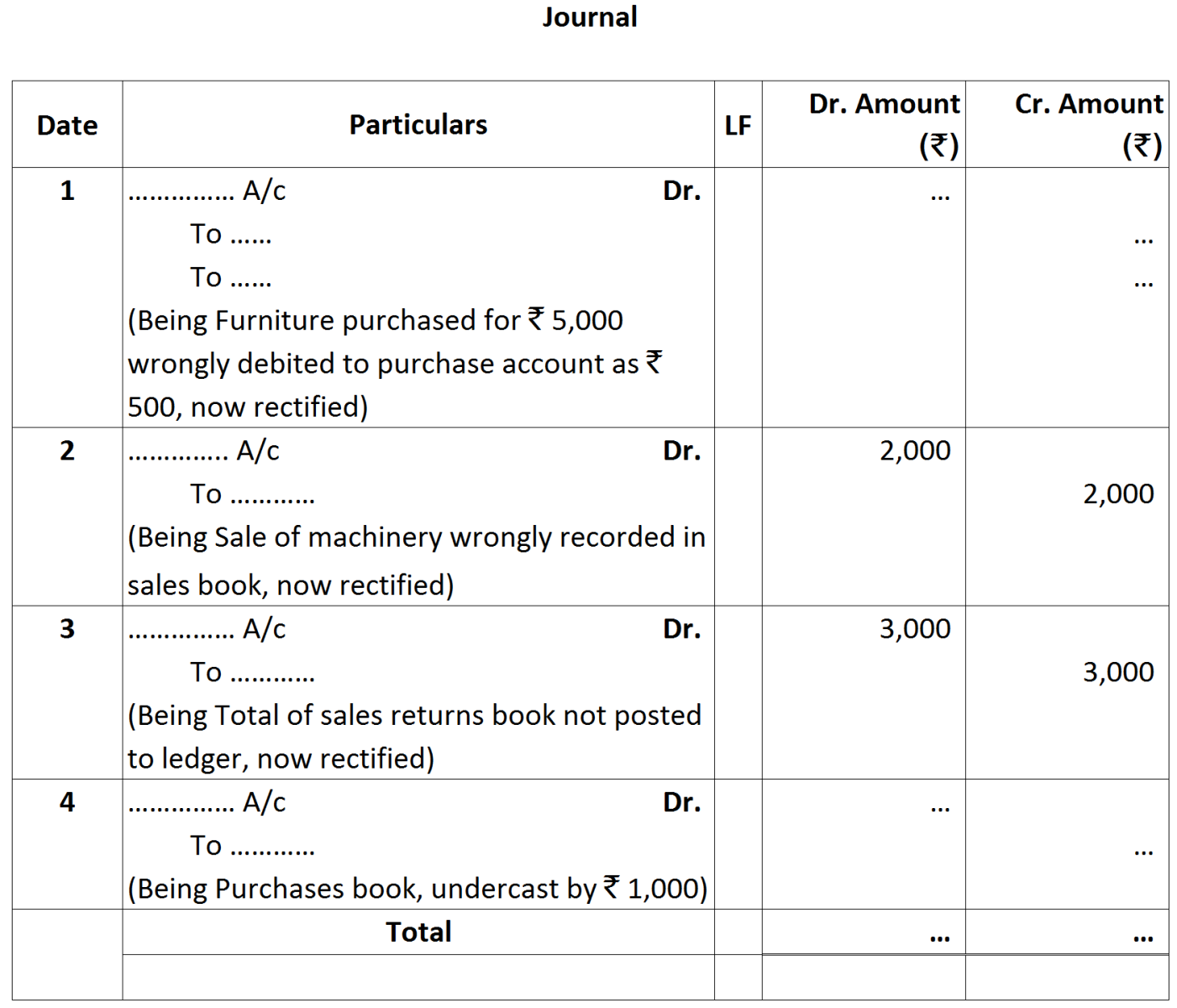
Question
Give five examples of Capital Reserve.

Answer

Examples of Capital Reserve:
  1. Profit prior to incorporation.
  2. Premium on issue of shares or debentures.
  3. Profit on redemption of debentures.
  4. Profit on forfeiture of shares, (u) Profit on sale of fixed assets.
  5. Capital Redemption Reserve.
  6. Profit on revaluation of fixed assets and liabilities.

Need a full question paper?

Generate a complete, print-ready paper with questions like this in minutes — across 16+ boards, with answer keys.

Start Generating Free

Similar questions

What is IGST? Give an example.
A Company purchased a second-hand machine on 1st April, 2016, for ₹ 30,000 and immediately spent ₹ 4,000 on its repair and ₹ 1,000 on its installation. On Oct. 1, 2018, the machine was sold for ₹ 25,000. Prepare Machine Account after charging depreciation @ 10% p.a. by diminishing balance method, assuming that the books are closed on 31st March every year. IGST was charged @12% on purchase and sale of machine.
Tiwari & Sons find that the bank balance shown by their Cash Book on 31st March, 2019 is ₹ 40,500 (credit) but the Pass Book shows a difference due to the following reasons:
  1. A cheque for ₹ 5,000 drawn in favour of Manohar has not yet been presented for payment.
  2. A post-dated cheque for ₹ 900 has been debited in the bank column of the Cash Book but it could not have been presented in any case.
  3. Cheques totalling ₹ 10,200 deposited with the bank have not yet been collected and a cheque for ₹ 4,000 has been dishonoured.
  4. A bill for ₹ 10,000 was retired by the Bank under a rebate of ₹ 150 but the full amount of the bill was credited in the bank column of the Cash Book.
Prepare Bank Reconciliation Statement and find out the balance as per Pass Book.
Enter the following transactions in a single column Cash Book:

2023


Mar-01

Commenced business with Cash

20,000

Mar-02

Bought goods for Cash

5,000

Mar-05

Sold goods for Cash

4,000

Mar-10

Goods purchased from Rajesh on Credit

10,000

Mar-13

Paid to Rajesh

7,000

Mar-15

Cash Sales

8,000

Mar-18

Purchased furniture for Cash

6,000

Mar-20

Paid Wages

380

Mar-24

Paid Rent

400

Mar-26

Received Commission

600

Mar-28

Withdrew for personal expenses

1,000

Mar-31

Paid Salary

900

Enumerate the steps to ascertain the correct cash book balance.
Complete the following Rectification Entries:
Distinguish between Bills of Exchange and Promissory Note on the following basis:
  1. Order or Promise and Parties.
  2. Acceptance.
  3. Payee.
  4. Noting.
From the following items prepare a Bank Reconciliation Statement on 31st May 2015:
  1. Bank balance as per Cash Book on 31st May 2015 ₹ 17,600.
  2. Cash and cheques totalling ₹ 36,000 were sent to bank during May but one cheque of ₹ 11,800 was shown in the Pass Book on 2nd June.
  3. As per instructions bankers have directly collected ₹ 4,100 from a customer but there is no mention of it in the Cash Book.
  4. Three cheques for ₹ 10,000, ₹ 12,000 and ₹ 4,800 respectively were drawn on 27th May but the cheque for ₹ 4,800 was encashed on 1st June.
  5. On 31st May bankers had debited ₹ 45 as bank charges but had intimated it on 3rd June.
  6. ₹ 16,200 were withdrawn from bank on 25th May but there is no entry for it in the Cash Book.
Rectify the following errors:
  1. The Sales Book has been totalled ₹ 1,000 short.
  2. Goods worth ₹ 1,500 returned by Green and Co. have not been recorded anywhere.
  3. Goods purchased worth ₹ 2,500 have been posted to the debit of the supplier, Gupta and Co.
  4. Furniture purchased from Gulab and Co. worth ₹ 10,000 has been entered in Purchases Day Book.
  5. Cash received from A ₹ 2,500 has not been posted in his account.
Rectify the following errors:
  1. Credit sales to Mridula ₹ 5,000 were not recorded.
  2. Credit purchases from Nayna ₹ 8,000 were not recorded.
  3. Goods returned to Priya ₹ 12,000 were not recorded.
  4. Goods returned from Rashi ₹ 10,000 were not recorded.