Question
Give its
(i) mathematical expression
(ii) graphical representation and
(iii) significance.
Answer

(i) mathematical expressionsuppose a gas occupies volume $\mathrm{V}_1$ when its pressure is $\mathrm{P} 1$; then
$\begin{aligned} & \mathrm{V}_1 \propto \frac{1}{\mathrm{P}_1} \text { or }

\mathrm{V}_1=\frac{\mathrm{k}}{\mathrm{P}_1} \\ & \mathrm{P}_1
\mathrm{~V}_1=\mathrm{k}=\mathrm{constant}\end{aligned}$
If $V_2$ is the volume ocuupied when the pressure is $P_2$ at the same temperature, the
$ \begin{aligned}& \mathrm{V}_2 \propto \frac{1}{\mathrm{P}_2} \text { or } \mathrm{V}_2=\frac{\mathrm{k}}{\mathrm{P}_2} \\& \mathrm{P}_2 \mathrm{~V}_2=\mathrm{k}=\mathrm{constant}\end{aligned}$
$\mathrm{P}_1\mathrm{~V}_1=\mathrm{P}_2 \mathrm{~V}_2=\mathrm{k}$ at constant temperature
This is called Boyle's law equation.
(ii) graphical representation
The law canbe verified by plotting a graph
(a) $\vee$ vs $\frac{1}{p}$(b) V vs P(c) PV vs P
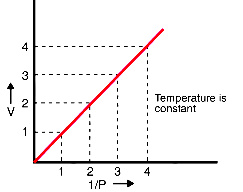
(a) (\mathrm{V}$ vs $\frac{1}{p}$ : a straight line passing through the origin is obtained

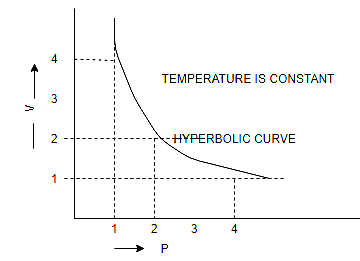
(b) V vs P: a hyperbolic curve in the first quadrant is obtained

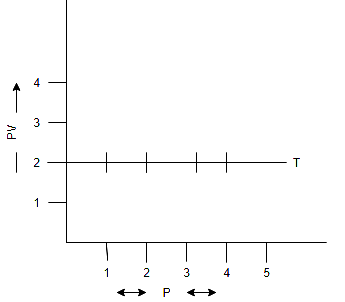
(c) PV vs P: a straight line is obtained parallel to the pressure axis.

(iii) Significance
On increasing pressure, volume decreases. The gasbecomes denser. Thus at a constant temperature, the density of a gas is directly proportional toits pressure.
Atmospheric pressure is low at high altitudes, so air is less dense. Hence, alesser quantity of oxygen is available for breathing. This is the reason why mountaineers have to carryoxygen cylinders with them.

Need a full question paper?

Generate a complete, print-ready paper with questions like this in minutes — across 16+ boards, with answer keys.

Start Generating Free

Similar questions

How can these impurities be removed?
How can we control carbon monoxide poisoning?
Complete the following table and write your observations.
Hydrogen sulphide Ammonia Sulphur dioxide Hydrogen chloride
Shake the gas with red litmus solution
Shake the gas with blue litmus solution
Apply a burning splint to a gas
A certain amount of a gas occupies a volume of 0.4 litre at 17°C. To what temperature should it be heated so that its volume gets (a) doubled, (b) reduced to half, pressure remaining constant?
What are stalgmites and stalactites? How are they formed?
A given amount of gas A is confined in a chamber of constant volume. When the chamber is immersed in a bath of melting ice, the pressure of the gas is 100cmHg.
  1. What is the temperature when the pressure is 10cmHg?
  2. What will be the pressure when the chamber is brought to 100°C
Define exothermic and endothermic changes. Give two example in each case.
A gas occupies $500 cm^3$ at a normal temperature. At what temperature will the volume of the gas be reduced by $20 \%$ of its original volume, the pressure is constant?
Two elements $P$ and $Q$ belong to the same period of the modern periodic table and are in group $1$ and group $2$, respectively. Compare the following characteristics in the tabular form.
  1. Number of electrons in their atoms
  2. Their tendency to lose electrons
  3. Their metallic characters
  4. Formation of their oxides
  5. Formulae of their chlorides
An element $X$ has $2$ electrons in its $M$ shell, it forms a bond with an element $Y$ which has $7$ electrons in its third orbit.
  1. Write the formula of the compound formed.
  2. Which nearest inert gas electronic configuration will element $X$ and $Y$ acquire.
  3. Show by orbital diagram the formation of the compound between $X$ and $Y.$