Question
Give the postulates of kinetic theory of gases. Derive the expression for pressure exerted by gas molecules in a container. Use it to relate kinetic energy with pressure.

Answer

The kinetic theory of gases is based on the following assumptions:
  1. A gas consists of a very large number of molecules which are perfect elastic spheres and identical in all respects for a given gas. These are different for different gases.
  2. The molecules of a gas are in a state of continuous, rapid and random motion in all directions with different speeds, ranging from zero to infinity and obey Newton's laws of motion.
  3. The size of the gas molecules is very small as compared to the distance between them. Hence, the volume occupied by the molecules, is negligible in comparison to the volume of the gas.
  4. The molecules do not exert any force of attraction or repulsion on each other, except during collision.
  5. The collisions of the molecules with themselves and with the walls of the vessels are perfectly elastic, i.e. the momentum and the kinetic energy of the molecules are conserved during collisions.
Expression for pressure due to an ideal gas:
Consider an ideal gas contained in a cubical container OPQRSTKL of each side a and having a volume V.
Clearly, volume of the gas, V = volume of the container = $a^3$, i.e. $V = a^3$.
Let there be n molecules of the gas in the container each of mass m. Then, the total mass of the gas in the container is given by
$M = m \times n$
Let the random velocities of the gas molecules $A_1, A_2, .... A_n,$ be $c_1, c_2, ..... c_n$ respectively. Let $(x_1, y_1, z_1), (x_2, y_2, z_2), ..... (x_n, y_n, z_n)$ be the rectangular components of the velocities $c_1, c_2, ... c_n$, respectively, along three mutually perpendicular directions Ox, OY and Oz.
$\begin{matrix}\text{x}^2_1+\text{y}^2_1+\text{z}^2_1=\text{c}^2_1\\\text{x}^2_2+\text{y}^2_2+\text{z}^2_2=\text{c}^2_2\\.................\\\text{x}^2_\text{n}+\text{y}^2_\text{n}+\text{z}^2_\text{n}=\text{c}^2_\text{n}\end{matrix}$
The change in momentum of $A_1$, along OX after one collision = $-mx_1 - mx_1 --2mx_1$
According to law of conservation of linear momentum, in one collision, the momentum transferred to the wall QRSL by the molecule $A_1$ will be = $+2mx_1$​​​​​​​
The molecule $A_1$ returned from face QRSL, collides against the wall OPKT, rebounds and again collides with QRSL. Thus, the molecule $A_1$ covers a distance 2a between two successive collisions with the wall QRSL.
$\therefore$ Time between two successive collisions, $\text{t}=\frac{\text{distance}}{\text{speed}}=\frac{2\text{a}}{\text{x}_1}$
It means the molecule $A_1​​​​​​​$ will collide with wall QRSL after every $\frac{2\text{a}}{\text{x}_1}$ seconds.
Therefore, number of collisions per second with wall QRSL $=\frac{1}{\text{t}}=\frac{\text{x}_1}{2\text{a}}$
$\therefore$ Momentum transferred to the wall QRSL in one second by molecule $A_1​​​​​​​$ = momentum transferred in one collision × no. of collisions in 1s.
$=2\text{mx}_1\times\frac{\text{x}_1}{2\text{a}}=\frac{\text{mx}^2_1}{\text{a}}$
According to Newton's 2nd law of motion, the rate of change of momentum of a body is equal to the force exerted on it. Hence, the force exerted by the molecule A, on the wall QRSL will be.
$\text{f}_1=\frac{\text{mx}^2_1}{\text{a}}$
$\text{f}_2=\frac{\text{mx}^2_2}{\text{a}},...\text{f}_\text{n}=\frac{\text{mx}^2_{\text{n}}}{\text{a}}$
Total force exerted by all the molecules on wall QRSL will be
$\text{F}_{\text{x}}=\frac{\text{mx}^2_1}{\text{a}}+\frac{\text{mx}^2_2}{\text{a}}+...+\frac{\text{mx}^2_\text{n}}{\text{a}}=\frac{\text{m}}{\text{a}}\big(\text{x}^2_1+\text{x}^2_2+\text{x}^2_{\text{n}}\big)$
$\therefore$ Pressure exerted on the wall QRSL is
$\text{P}_{\text{x}}=\frac{\text{force}}{\text{area of wall QRSL}}=\frac{\text{F}_{\text{x}}}{\text{a}^2}=\frac{\text{m}}{\text{a}^3}\big(\text{x}^2_1+\text{x}^2_2+...+\text{x}^2_\text{n}\big)$
Similarly, the pressure exerted by the gas molecules perpendicular to OY and OZ respectively are given by
$\text{P}_{\text{y}}=\frac{\text{m}}{\text{a}^3}\big(\text{y}^2_1+\text{y}^2_2+...+\text{y}^2_{\text{n}}\big)$
and $\text{P}_{\text{z}}=\frac{\text{m}}{\text{a}^3}\big(\text{z}^2_1+\text{z}^2_2+...+\text{z}^2_{\text{n}}\big)$
Since the molecular density is uniform throughout the gas, therefore the pressure exerted by the molecules is the same in all directions. Hence,
$\text{P}_{\text{x}}=\text{P}_{\text{y}}=\text{P}_{\text{z}}=\text{p}$ (say)
$\therefore\text{P}_{\text{x}}+\text{P}_{\text{y}}+\text{P}_{\text{z}}=3\text{P}$
or $\text{P}=\frac{\text{P}_{\text{x}}+\text{P}_{\text{y}}+\text{P}_{\text{z}}}{3}$
$\text{P}=\frac{1}{3}\Big[\frac{\text{m}}{\text{a}^3}\big(\text{x}^2_1+\text{x}^2_2+...+\text{x}^2_\text{n}\big)+\frac{\text{m}}{\text{a}^3}\big(\text{y}^2_1+\text{y}^2_2+...+\text{y}^2_{\text{n}}\big)\\+\frac{\text{m}}{\text{a}^3}\big(\text{z}^2_1+\text{z}^2_2+...+\text{z}^2_{\text{n}}\big)\Big]$
$=\frac{\text{m}}{3\text{a}^3}\Big[\big(\text{x}^2_1+\text{x}^2_2+...+\text{x}^2_{\text{n}}\big)+\big(\text{y}^2_1+\text{y}^2_2+...+\text{y}^2_{\text{n}}\big)\\+\big(\text{z}^2_1+\text{z}^2_2+...+\text{z}^2_{\text{n}}\big)\Big]$
$\text{P}=\frac{\text{m}}{3\text{a}^3}\Big[\big(\text{x}^2_1+\text{y}^2_1+\text{z}^2_1\big)+\big(\text{x}^2_2+\text{y}^2_2+\text{z}^2_2\big)\\+...+\big(\text{x}^2_\text{n}+\text{y}^2_\text{n}+\text{z}^2_\text{n}\big)\Big]$
$=\frac{\text{m}}{3\text{V}}\big[\text{c}^2_1+\text{c}^2_2+...+\text{c}^2_\text{n}\big]=\frac{1}{3}\frac{\text{mv}}{\text{V}}\Big[\frac{\text{c}^2_1+\text{c}^2_2+...+\text{c}^2_\text{n}}{\text{n}}\Big]$
$\text{P}=\frac{\text{M}}{3\text{V}}\text{c}^2$
where $\text{c}=\sqrt{\frac{\text{c}^2_1+\text{c}^2_2+...+\text{c}^2_\text{n}}{\text{n}}}$ is called the root mean square (r.m.s.) velocity of the gas molecules.
Relation of K.E. with pressure:
Pressure $\text{P}=\frac{1}{3}\frac{\text{nmc}^2}{\text{V}}=\frac{1}{3}\frac{\text{M}}{\text{V}}\text{c}^2$
$\Rightarrow\text{P}=\frac{1}{3}\rho\text{c}^2$ $\Big[\because\frac{\text{M}}{\text{V}}=\rho\Big]$
Mean K.E. of translation per unit volume of gas is E $=\frac{1}2{}\rho\text{c}^2$
$\therefore\frac{\text{P}}{\text{E}}=\frac{\frac{1}{3}\rho\text{c}^2}{\frac{1}{2}\rho\text{c}^2}=\frac{2}{3}$
$\text{P}=\frac{2}{3}\text{E}$

Need a full question paper?

Generate a complete, print-ready paper with questions like this in minutes — across 16+ boards, with answer keys.
Start Generating Free

Similar questions

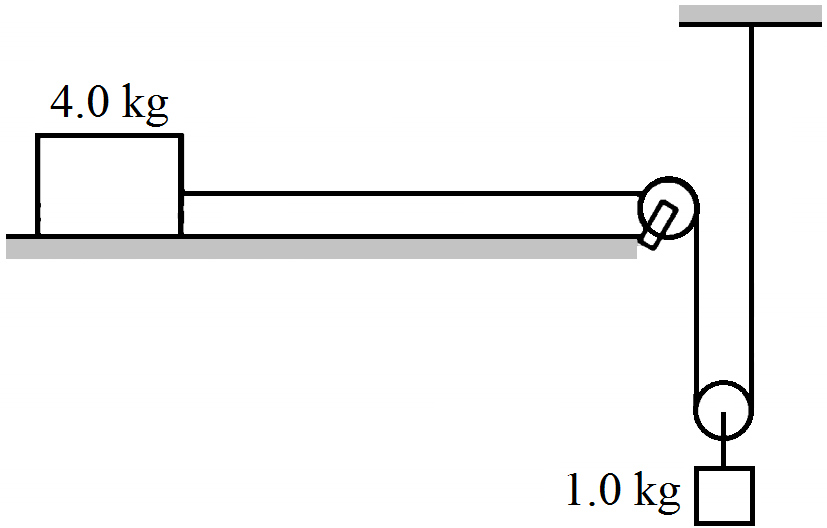
Consider the situation shown in figure. The system is released from rest and the block of mass $1.0kg$ is found to have a speed $0.3m/s$ after it has descended through a distance of $1m$. Find the coefficient of kinetic friction between the block and the table.
A bullet of mass 20g moving horizontally at a speed of 300m/s is fired into a wooden block of mass 500g suspended by a long string. The bullet crosses the block and emerges on the other side. If the centre of mass of the block rises through a height of 20.0cm, find the speed of the bullet as it emerges from the block.
A sonometer wire is vibrating in resonance with a tuning fork. Keeping the tension applied same, the length of the wire is doubled. Under what conditions would the tuning fork still be is resonance with the wire?
A long wire carries a current of 4.00A. Find the energy stored in the magnetic field inside a volume ot 1.00mm at a distance of 10.0cm from the wire.
A pipe $20cm$ long is closed at one end. Which harmonic mode of the pipe is resonantly excited by a $430Hz$ source? Will the same source be in resonance with the pipe if both ends are open? (speed of sound in air is $340m s^{–1}$).
At what temperature is the root mean square speed of oxygen atom equal to the r.m.s. speed of helium gas atom at $-10^\circ C$? Atomic mass of oxygen = $32$ and that of helium = $4.0$.
A container of volume $50cc$ contains air (mean molecular weight = $28.8g$) and is open to atmosphere where the pressure is $100kPa$. The container is kept in a bath containing melting ice $(0^\circ C)$.
  1. Find the mass of the air in the container when thermal equilibrium is reached.
  2. The container is now placed in another bath containing boiling water $(100^\circ C)$. Find the mass of air in the container.
  3. The container is now closed and placed in the melting-ice bath. Find the pressure of the air when thermal equilibrium is reached.
An object falling through a fluid is observed to have acceleration given by a = g - bv where g = gravitational acceleration and b is constant. After a long time of release, it is observed to fall with constant speed. What must be the value of constant speed?
A smooth sphere of radius R is made to translate in a straight line with a constant acceleration a. A particle kept on the top of the sphere is released from there at zero velocity with respect to the sphere. Find the speed of the particle with respect to the sphere as a function of the angle $\theta$ it slides.
Two ideal gases have the same value of $\frac{\text{C}_\text{P}}{\text{C}_\text{V}}=\gamma.$ What will be the value of this ratio for a mixture of the two gases in the ratio $1 : 2$?