Question
Give three points of differences between inductive effect and resonance effect.
| Inductive effect | Resonance effect |
| Based on electronegativity. | Based on Conjugation. |
| Electron moves via sigma bonds. | Electron moves via pi bonds or lone pairs. |
| It involves displacement of only $\sigma$ electrons and hence occurs only in saturated compounds. | It involves delocalization of $\pi$ (pi) or n lone pairs of electrons and hence occurs in unsaturated and conjugated systems. |
| During inductive effect the electron pair is only slightly displaced towards the more electronegative atom and hence only partial positive and negative charges appear. | During resonance effect, the electron pair I completely transferred and hence full positive and negative charges appear. |
| Inductive effect are transmitted over short distance over short distances in saturated carbon chains and the magnitude of the effect decreases rapidly as distance from the heteroatom increases. The effects almost become negligible beyond three carbon atoms from the heteroatom. | The resonance effect is transmitted all along the length of the conjugated system without suffering much change in magnitude.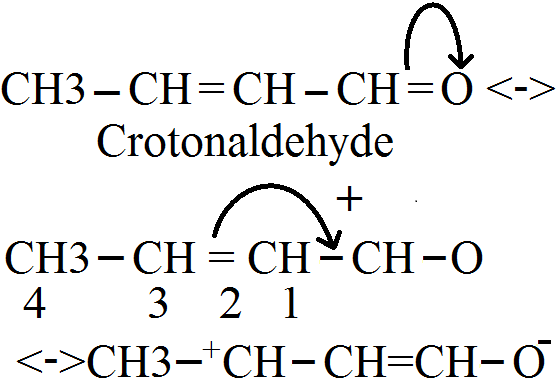 C3 in crotonaldehyde is almost as positive as C1. |
| Distance short range. | Distance may be long range. |
Generate a complete, print-ready paper with questions like this in minutes — across 16+ boards, with answer keys.
$\text{CH}_{3}=\text{CH}-\text{C}-\text{O}-\text{H}$
$\text{CH}_{3}-\text{CH}_{2}-\text{OH}$
$\text{CH}_{3}-\text{CH}_{2}-\text{C}-\text{H}$
$\text{CH}_{3}-\text{CH}=\text{CH}-\text{CH}_{3}$
$\text{CH}_{3}-\text{C}\equiv\text{CH}$
Comprehension given below is followed by some multiple choice questions. Each question has one correct option. Choose the correct option.
Molecular orbitals are formed by the overlap of atomic orbitals. Two atomic orbitals combine to form two molecular orbitals called bonding molecular orbital (BMO) and anti bonding molecular orbital (ABMO). Energy of anti bonding orbital is raised above the parent atomic orbitals that have combined and the energy of the bonding orbital is lowered than the parent atomic orbitals. Energies of various molecular orbitals for elements hydrogen to nitrogen increase in the order.
Different atomic orbitals of one atom combine with those atomic orbitals of the second atom which have comparable energies and proper orientation. Further, if the overlapping is head on, the molecular orbital is called ‘Sigma’, and if the overlap is lateral, the molecular orbital is called ‘pi’. The molecular orbitals are filled with electrons according to the same rules as followed for filling of atomic orbitals. However, the order for filling is not the same for all molecules or their ions. Bond order is one of the most important parameters to compare the strength of bonds.
$\text{MnO}_2+4\text{HCl}\xrightarrow{ \ \ \ \ \ \ \ }\text{MnCl}_2+\text{Cl}_2+2\text{H}_2\text{O}$
$2\text{MnO}_4^-10\text{Cl}^-+16\text{H}^+\\ \xrightarrow{ \ \ \ \ }2\text{Mn}^{2+}+5\text{Cl}_2+8\text{H}_2\text{O}$
Calculate the oxidation number of underlined elements in the following speries.
$\text{Pb}_3\text{O}_4,$ $\text{H}_2\text{Cl}$, $\text{PO}_4^{3-}$