Question
Give two advantages of GST.

Answer

  1. Developing Common National Market by having One Indirect Tax: GST is a step towards development of Common National Market by levy of one Indirect Tax (GST) and thus, facilitating free flow of goods and/or services across India.
  2. Decrease in Cost of Goods by Removing Cascading Effect of Indirect Taxes: GST Paid (Input GST) is set off against GST Collected (Output GST). Thus, in effect, GST is charged on the value added in the subsequent sales. As a result, cascading effect is removed. With the removal of cascading effect of indirect taxes (tax on tax effect) and allowing credit of GST Paid against GST Collected, goods and/or services shall cost less.
  3. Ease of Doing Business: GST is a comprehensive indirect tax meaning that almost all the indirect taxes (except tax on petroleum, duties on alcohol for human consumption, customs duty and taxes levied by local bodies) are merged into it. Also, with improved harmonised indirect tax administration, setting up and carrying on of business has become easier.
  4. Attracting Foreign Direct Investment (FDI): GST will attract foreign investment as a major barrier for attracting FDI is removed.

Need a full question paper?

Generate a complete, print-ready paper with questions like this in minutes — across 16+ boards, with answer keys.
Start Generating Free

Similar questions

Mr. Gopal started business for buying and selling of readymade garments with ₹ 8,00,000 as an initial investment. Out of this he paid ₹ 4,00,000 for the purchase of garments and ₹ 50,000 for furniture and ₹ 50,000 for computers and the remaining amount was deposited into the bank. He sold some of the ladies and kids garments for ₹ 3,00,000 for cash and some garments for ₹ 1,50,000 on credit to Mr. Rajesh.
Subsequently, he bought men's garments of ₹ 2,00,000 from Mr. Satish. In the first week of the next month, a fire broke out in his office and stock of garments worth ₹ 1,00,000 was destroyed. Later on, some garments which cost ₹ 1,20,000 were sold for ₹ 1,30,000. Expenses paid during the same period were ₹ 15,000. Mr. Gopal withdrew ₹ 20,000 from business for his domestic use.
From the above, answer the following:
  1. What is the amount of capital with which Mr. Gopal started the business?
  2. What fixed assets did he buy?
  3. What is the value of the goods purchased?
  4. Who is the creditor and state the amount payable to him?
  5. Who is the debtor and what is the amount receivable from him?
  6. What is the total amount of expenses?
  7. What is the amount of drawings of Mr. Gopal?
Rectify the following errors:
  1. Furniture purchased for ₹ 10,000 wrongly debited to purchases account.
  2. Machinery purchased on credit from Raman for ₹ 20,000 was recorded through purchases book.
  3. Repairs on machinery ₹ 1,400 debited to machinery account.
  4. Repairs on overhauling of secondhand machinery purchased ₹ 2,000 was debited to Repairs account.
Briefly appreciate the exact nature of accounting.
Balance as per passbook of Mr. Kumar is 3,000.
  1. Cheque paid into bank but not yet cleared Ram Kumar ₹ 1,000 Kishore Kumar ₹ 500
  2. Bank Charges ₹ 300
  3. Cheque issued but not presented Hameed ₹ 2,000 Kapoor ₹ 500
  4. Interest entered in the passbook but not entered in the cash book ₹ 100 Prepare a bank reconciliation statement.
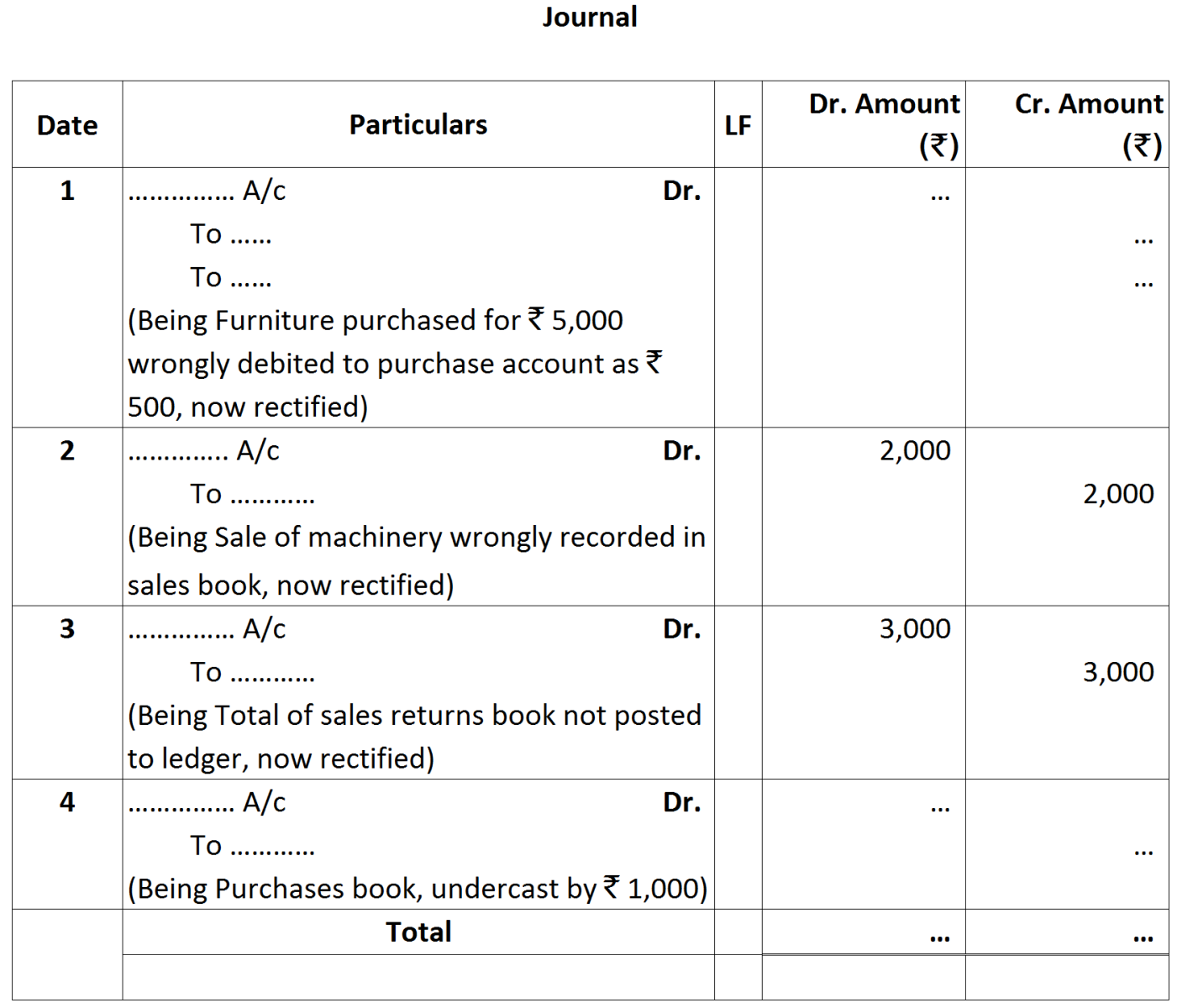
Complete the following Rectification Entries:
From the following particulars, prepare a, bank reconciliation statement as at March 31, 2017.
  1. Balance as per cash book ₹ 3,200
  2. Cheque issued but not presented for payment₹ 1,800
  3. Cheque deposited but not collected upto March 31, 2014 ₹ 2000
  4. Bank charges debited by bank ₹ 150
Enter the following transactions in the Double Column Cash Book of M/s. Gupta Store:
2019
 
June 1
Cash in Hand ₹ 800, Bank overdraft ₹ 5,700
 
June 7
Received a cheque from Bharati, discount allowed ₹ 150
3,250
June 9
Deposited the above cheque into Bank
 
June 15
Cheque received from Panna Lal
1,200
June 20
Bharati's cheque returned dishonoured
 
June 28
Panna Lal's cheque was endorsed to Kamal
 
June 30
Income tax paid by cheque
150
On April 01, 2010 Jain & Sons purchased a second hand plant costing ₹ 2,00,000 and spent ₹ 10,000 on its overhauling. It also spent ₹ 5,000 on transportation and installation of the plant. It was decided to provide for depreciation @ 20% on written down value. The plant was destroyed by fire on Oct. 31, 2013 and an insurance claim of ₹ 50,000 was admitted by the insurance company. Prepare plant account assuming that the company closes its books on March 31, every year.
Briefly explain your understanding of IFRS.
From the following items prepare a Bank Reconciliation Statement on 31st May 2015:
  1. Bank balance as per Cash Book on 31st May 2015 ₹ 17,600.
  2. Cash and cheques totalling ₹ 36,000 were sent to bank during May but one cheque of ₹ 11,800 was shown in the Pass Book on 2nd June.
  3. As per instructions bankers have directly collected ₹ 4,100 from a customer but there is no mention of it in the Cash Book.
  4. Three cheques for ₹ 10,000, ₹ 12,000 and ₹ 4,800 respectively were drawn on 27th May but the cheque for ₹ 4,800 was encashed on 1st June.
  5. On 31st May bankers had debited ₹ 45 as bank charges but had intimated it on 3rd June.
  6. ₹ 16,200 were withdrawn from bank on 25th May but there is no entry for it in the Cash Book.