Question
Give two examples each of longitudinal waves and transverse waves.

Answer

Longitudinal waves:
  1. The waves which travel along a spring when it is pushed and pulled at one end.
  2. Sound waves in air.
Transverse waves:
  1. The waves produced by moving one end of a long spring up and down rapidly, while other end is fixed.
  2. The water waves or ripples formed on the surface of water in a pond.

Need a full question paper?

Generate a complete, print-ready paper with questions like this in minutes — across 16+ boards, with answer keys.
Start Generating Free

Similar questions

Describe the mechanism of crop variety improvement.
One of the forms of a naturally occurring solid compound $P$ is usually used for making the floors of houses. On adding a few drops of dilute hydrochloric acid to $P,$ brisk effervescence are produced. When $50g$ of reactant $P$ was heated strongly, than $22g$ of a gas $Q$ and $28g$ of a solid $R$ were produced as products. Gas $Q$ is the same which produced brisk effervescence on adding dilute $\text{HCl}$ to$ P.$ Gas $Q$ is said to cause global warming whereas solid $R$ is used for white$-$washing.
  1. What is $(i)$ solid $P (ii)$ gas $Q,$ and $(iii)$ solid $R.$
  2. What is the total mass of $Q$ and $R$ obtained from $50g$ of $P$?
  3. How does the total mass of $Q$ and $R$ formed compare with the mass of $P$ taken?
  4. What conclusion do you get from the comparison of masses of products and reactant?
  5. Which law of chemical combination is illustrated by the example given in this problem?
What are the postulates of Bohr’s model of an atom?
Discuss the various methods which are used to control plant diseases.

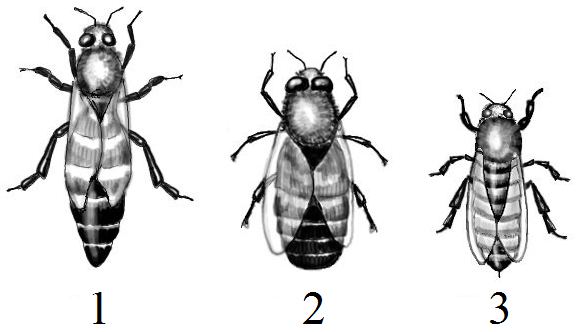
Look at Figures 1, 2 and 3 given alongside and answer the following questions.
  1. What do these figures show all together?
  2. Which one is queen bee?
  3. Which one of them is the haploid, fertile male? What is it called?
  4. What is the status of the insect shown in the figure: individual/ social?
If the distance between two masses is increased by a factor of $5,$ by what factor would the mass of one of them have to be altered to maintain the same gravitational force? Would this be an increase or decrease in the mass?
Which has more atoms, $50g$ of aluminium or $50g$ of iron$?$ Illustrate your answer with the help of calculations.
$($Atomic masses: $Al = 27u; Fe = 56u)$
What mass of nitrogen $N_2,$ will contain the same number of molecules as $1.8g$ of water, $H_2O?$
$($Atomic masses: $N = 14u; H = 1u; O = 16u)$
How will you separate a mixture of iron filings, chalk powder an common salt?
A stone falls from a building and reaches the ground $2.5$ seconds later. How high is the building? $(g = 8\ m/s^2)$