MCQ
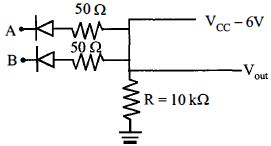
Given $A$ and $B$ are input terminals. Logic $1\, = \,> 5\, V$ Logic $0\, =\, < 1\, V$ Which logic gate operation, the above circuit does?
  • $AND$ Gate
  • B
    $OR$ Gate
  • C
    $XOR$ Gate
  • D
    $NOR$ Gate

Answer

Correct option: A.
$AND$ Gate
a
$AND$ Gate

Need a full question paper?

Generate a complete, print-ready paper with questions like this in minutes — across 16+ boards, with answer keys.

Start Generating Free

Similar questions

A polyatomic gas with $n$ degrees of freedom has a mean energy per molecule given by

($N$ is Avogadro's number)

A man of mass $50 \,kg$ carries a bag of weight $40 \,N$ on his shoulder. The force with which the floor pushes up his feet will be ......... $N$
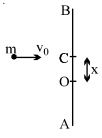
$A$ uniform rod $AB$ of length $L$ and mass $M$ is lying on a smooth table. $A$ small particle of mass $m$ strike the rod with a velocity $v_0$ at point $C$ at a distance $x$ from the centre $O$. The particle comes to rest after collision. The value of $x$, so that point $A$ of the rod remains ststionary just after collision is:
If the magnetic dipole moment of an atom of diamagnetic material, paramagnetic material and ferromagnetic material denoted by ${\mu _d},\,{\mu _p},\,{\mu _f}$ respectively then
The photoelectric threshold of Tungsten is $2300\; \mathring A$. The energy of the electrons ejected from the surface by ultraviolet light of wavelength $1800\; \mathring A$ is $.............\,eV$
According to the theorem of parallel axes $I = {I_g} + M{d^2}$, the graph between $I$ and $d$ will be
A uniform rope of mass $6\,kg$ hangs vertically from a rigid support. A block of mass $2\,kg$ is attached to the free end of the rope. A transverse pulse of wavelength $0.06\,m$ is produced at the lower end of the rope. The wavelength of the pulse when it reaches the top is (in $m$ )
If the dip circle is set at $45^o$ to the magnetic meridian, then the apparent dip is $30^o$. The true dip. of the place is
Which of the following is the correct order of forces
Energy of $10$ non rigid diatomic molecules at temperature $\mathrm{T}$ is :