Question
Given a uniformly charged plane/sheet of surface charge density, $\sigma=2\times10^{17}\text{C/m}^2.$

Image

  1. Find the electric field intensity at a point A, 5mm away from the sheet on the left side.
  2. Given a straight line with three points X, Y and Z placed 50cm away from the charged sheet on the right side. At which of these points, the field due to the sheet remain the same as that of point A and why?

Answer

  1. At A, $\text{E}=\frac{\sigma}{2\in_0}=\frac{2\times10^{17}\text{Cm}^{-2}}{2\times8.854\times10^{-12}\text{C}^2\text{N}^{-1}\text{m}^{-2}}$

$\text{E}=1.1\times1028 \text{N/C}$

Directed away from the sheet.

  1. Point Y, Because at 50cm, the charge sheet acts as a finite sheet and thus the magnitude remains same towards the middle region of the planar sheet.

Need a full question paper?

Generate a complete, print-ready paper with questions like this in minutes — across 16+ boards, with answer keys.

Start Generating Free

Similar questions

Two electric charges $+Q$ and $-Q(x-y)$ are placed at the points $\left(-x_2, 0\right)$ and $\left(x_1, 0\right)$ respectively in the plane. Find the magnitude and direction of the resultant electric field at the origin $(0,0)$.
If a charge is placed at rest in an electric field, will its path be along a line of force? Discuss the situation when the lines of force are straight and when they are curved.
A polythene piece rubbed with wool is found to have a negative charge of 3 × 10⁻⁷ C.
  1. Estimate the number of electrons transferred (from which to which?)
  2. Is there a transfer of mass from wool to polythene?
When a photon is emitted from an atom, the atom recoils. The kinetic energy of recoil and the energy of the photon come from the difference in energies between the states involved in the transition. Suppose, a hydrogen atom changes its state from n = 3 to n = 2. Calculate the fractional change in the wavelength of light emitted, due to the recoil.
Draw a graph showing the variation of decay rate with number of active nuclei.
Find the energy liberated in the reaction:
223Ra → 209Pb + 14C.
The atomic masses needed are as follows.
223Ra 209Pb 14C
22.018u 208.981u 14.003u
A vessel contains water upto a height of 20cm and above it an oil upto another 20cm. The refractive indices of the water and the oil are 1.33 and 1.30 respectively. Find the apparent depth of the vessel when viewed from above.
Suppose the rod in the previous problem has a mass of 1kg distributed uniformly over its length:
  1. Find the initial angular acceleration of the rod.
  2. Find the tension in the supports to the blocks of mass 2kg and 5kg.
A 12 pF capacitor is connected to a 50 V battery. How much electrostatic energy is stored in the capacitor? If another capacitor of 6 pF is connected in series with it with the same battery connected across the combination, find the charge stored and potential difference across each capacitor.
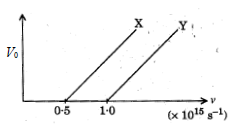
The following graph shows the variation of stopping potential V0 with the frequency v of the incident radiation for two photosensitive metals X and Y:

  1. Which of the metals has larger threshold wavelength? Give reason.
  2. Explain, giving reason, which metal gives out electrons, having larger kinetic energy, for the same wavelength of the incident radiation.
  3. If the distance between the light source and metal X is halved, how will the kinetic energy of electrons emitted from it change? Give reason.