Question
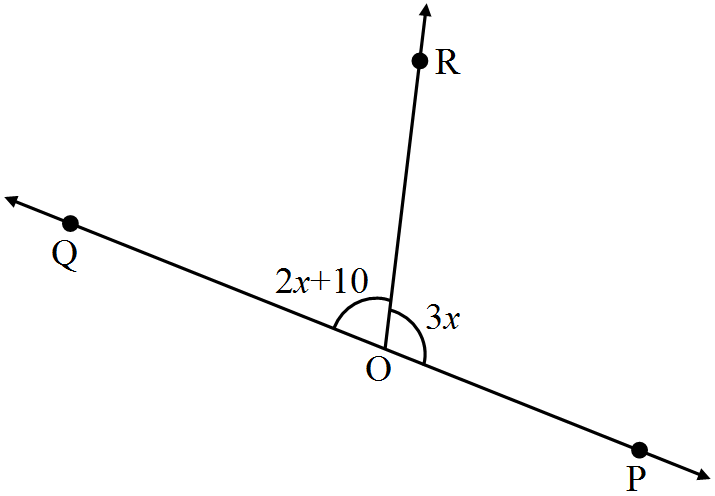
Given $\angle\text{POR}=3\text{x}$ and $\angle\text{QOR}=2\text{x}+10,$ Find the value of x for which POQ will be a line. (Figure 10.41).
Answer

For the case that POR is a line$\angle\text{POR}$ and $\angle\text{QOR}$ are linear parts
$\angle\text{POR}+\angle\text{QOR}=180^\circ$
Also, given that,$\angle\text{POR}=3\text{x}$ and $\angle\text{QOR}=2\text{x}+10$
2x + 10 + 3x = 180 5x + 10 = 180 5x = 180 - 10 5x = 170 x = 34 Hence the value of x is 34°

Need a full question paper?

Generate a complete, print-ready paper with questions like this in minutes — across 16+ boards, with answer keys.

Start Generating Free

Similar questions

If P is any point in the interior of a parallelogram ABCD, then prove that area of the triangle APB is less than half the area of parallelogram.
Using the remainder theorem, find the remainder, when $p(x)$ is divided by $g(x)$, where,
$p(x)=x^3-6 x^2+9 x+3, g(x)=x-1$.
A sports club has organised a table-tennis tournaments. The following table gives the distribution of players ages. Find the cumulative frequencies equal to or more than the lower class limit and complete the table 
Find the area of an equilateral triangle having each side x cm.
Divide $x^4 - 5x^2 - 4x by x + 3$ and find the remainder(using reminder theorem).
The height of a conical vessel is 3.5cm. If its capacity is 3.3 litres of milk. Find its diameter of its base.
If $a + b = 8 $and $ab = 6$, find the value of $a^3 + b^3.$
The percentage of marks obtained by a student in the monthly unit tests are given below:
Unit Test
I
II
III
IV
V
Percentage of Mark Obtained
69
71
73
68
76
Find the probability that the student gets:
  1. More than 70% marks.
  2. Less than 70% marks.
  3. A distinction
If x = -2 and y = 1, by using an identity find the value of the following:$\Big(\frac{2}{\text{x}}-\frac{\text{x}}{2}\Big)\Big(\frac{4}{\text{x}^2}+\frac{\text{x}^2}{4}+1\Big)$
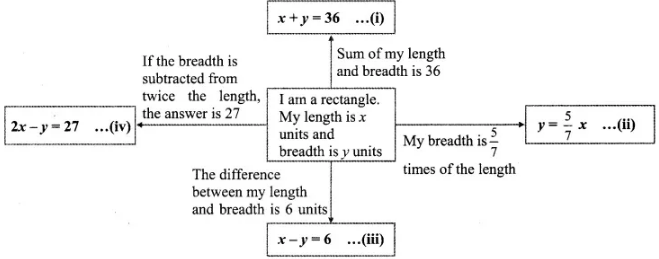
There are instructions written near the arrows in the following diagram. From this information form suitable equations and write in the boxes indicated by arrows. Select any two equations from these boxes and find their solutions. Also verify the solutions. By taking one pair of equations at a time, how many pairs can be formed ? Discuss the solutions for these pairs.

Image