Question
Given below are some famous numbers associated with electromagnetic radiations in different contexts in physics. State the part of the electromagnetic spectrum to which each belongs.
  1. 21 cm (wavelength emitted by atomic hydrogen in interstellar space).
  2. 1057 MHz (frequency of radiation arising from two close energy levels in hydrogen; known as Lamb shift).
  3. 2.7 K [temperature associated with the isotropic radiation filling all space-thought to be a relic of the ‘big-bang’ origin of the universe].
  4. 5890 Å - 5896 Å [double lines of sodium]
  5. 14.4 keV [energy of a particular transition in 57Fe nucleus associated with a famous high resolution spectroscopic method (Mössbauer spectroscopy)].
Answer

  1. Radio waves; it belongs to the short wavelength end of the electromagnetic spectrum.
  2. Radio waves; it belongs to the short wavelength end.
  3. Temperature, T = 2.7 °K

$\lambda_\text{m}$ is given by Planck's law as:

$\lambda_\text{m}=\frac{0.29}{2.7}=0.11 \ \text{cm}$

This wavelength corresponds to microwaves.

  1. This is the yellow light of the visible spectrum.
  2. Transition energy is given by the relation,

E = hv

Where,

h = Planck's constant = 6.6 × 10⁻³⁴ Js

v = Frequency of radiation

Energy, E = 14.4 K eV 

$\therefore \ \text{v}=\frac{\text{E}}{\text{h}}$

$=\frac{14.4\times10^3\times1.6\times10^{-19}}{6.6\times10{-34}}$

= 3.4 × 1018 Hz

This corresponds to X-rays.

Need a full question paper?

Generate a complete, print-ready paper with questions like this in minutes — across 16+ boards, with answer keys.

Start Generating Free

Similar questions

4.0g of helium occupies 22400cm3 at STP. The specific heat capacity of helium at constant pressure is 5.0cal-K-1mol-1. Calculate the speed of sound in helium at STP.
Why does blowing over a spoonful of hot tea cools it? Does evaporation play a role? Does radiation play a role?
When a proton is released from rest in a room, it starts with an initial acceleration a0 towards west. When it is projected towards north with a speed v0, it moves with an initial acceleration 3a0 towards west. Find the electric field and the maximum possible magnetic field in the room.
A glass surface is coated by an oil film of uniform thickness 1.00 × 10⁻⁴cm. The index of refraction of the oil is 1.25 and that of the glass is 1.50. Find the wavelengths of light in the visible region (400nm - 750nm) which are completely transmitted by the oil film under normal incidence.
A given coin has a mass of 3.0 g. Calculate the nuclear energy that would be required to separate all the neutrons and protons from each other. For simplicity assume that the coin is entirely made of $^{63}_{29}\text{Cu}$ atoms (of mass 62.92960 u).
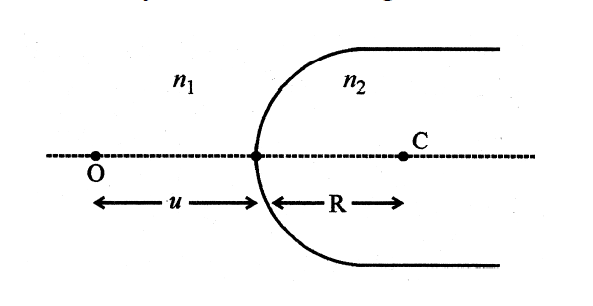
A point object 'O' is kept in a medium of refractive index n1 in front of a convex spherical surface of radius of curvature R which separates the second medium of refractive index n2 from the first one, as shown in the figure. Draw the ray diagram showing the image formation and deduce the relationship between the object distance and the image distance in terms of n1, n2 and R.

  1.  

  1. hen the image formed above acts as a virtual object for concave spherical, surface separating the medium n2 from n1 (n2> n1), draw this ray diagram and write the similar (similar to (a) relation. Hence obtain the expression for the lens maker's formula.
Figure shows a smooth track which consists of a straight inclined part of length 1 joining smoothly with the circular part. A particle of mass m is projected up the incline from its bottom.
  1. Find the minimum projection-speed v0, for which the particle reaches the top of the track.
  2. Assuming that the projection-speed is 2v0 and that the block does not lose contact with the track before reaching its top, find the force acting on it when it reaches the top.
  3. Assuming that the projection-speed is only slightly greater than v0, where will the block lose contact with the track?
A hollow sphere of radius 2cm is attached to an 18cm long thread to make a pendulum. Find the time period of oscillation of this pendulum. How does it differ from the time period calculated using the formula for a simple pendulum?
Verify the Gauss’s law for magnetic field of a point dipole of dipole moment m at the origin for the surface which is a sphere of radius R.
With the help of a labelled diagram, explain how does an AC works. There are $N$ turns in coil of AC generator. Area of each turn is A and the coil is rotating with a uniform angular velocity. Establish an expression for generated induced electromotive force. What is the source of energy production by this method?