Question
Given below are some functions of x and t to represent the displacement of an elastic wave.
$\text{y}=5\cos(4\times)\sin(20\text{t})$

Answer

A travelling wave along (-x) direction must have $+\text{kx}\ \text{i}.\text{e}.,$ in $(\text{iv})\text{y}=100\cos(100\pi\text{t}+0.5)$ so (a) (iv).

Need a full question paper?

Generate a complete, print-ready paper with questions like this in minutes — across 16+ boards, with answer keys.
Start Generating Free

Similar questions

The shapes and thickness of the walls of two containers made of different metals are similar in all respects. If equal quantities of ice filled in both the containers melt completely in 10 minute and 25 minutes respectively, then find the ratio of the coefficient thermal conductivity of the materials of the containers.
A car is lifted by a hydraulic jack that consist of two pistons. The large piston is 1m in diameter and small piston is 10cm in diameter. If W is the weight of the car, how much smaller a force is needed on the small piston to lift the car?
What is the energy required for 1gm of ice to become steam?
A diatomic gas is heated in a vessel to a temperature of 10000K. If each molecule possess an average energy $E_1$. After sometime, a few molecule escape into the atmosphere at 300 K. Due to which, their energy changes to $E_2​​​​​​​$. Calculate the ratio of $\frac{\text{E}_1}{\text{E}_2}.$
Two syringes of different cross$-$sections $($without needles$)$ filled with water are connected with a tightly fitted rubber tube filled with water. Diameters of the smaller piston and larger piston are $1.0 \ cm$ and $3.0 \ cm$ respectively. $(a)$ Find the force exerted on the larger piston when a force of $10 N$ is applied to the smaller piston. $(b)$ If the smaller piston is pushed in through $6.0 \ cm,$ how much does the larger piston move out?
A simple pendulum of a length l and having a bob of mass M is suspended in a car. The car is moving on a circular track of radius R with a uniform speed v. If the pendulum makes small oscillations in a radial direction about its equilibrium position, what will be its time period?
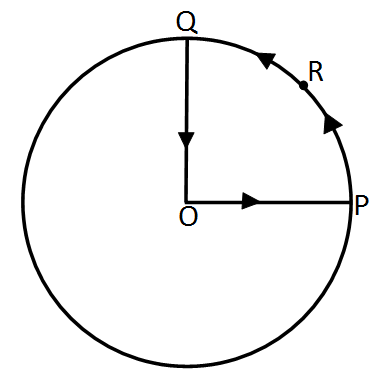
A cyclist starts from centre O of a circular park of radius 1km and moves along the path OPRQO as shown Fig. If he maintains constant speed of $10 \mathrm{~ms}^{-1}$, what is his acceleration at point R in magnitude and direction?
Two trains of lengths 109 m and 91 m are moving in opposite directions with velocities $34 \mathrm{~km} \mathrm{~h}^{-1}$ and $38 \mathrm{~km} / \mathrm{h}^{-1}$ respectively. In what time the two trains will completely cross each other? Choose the most logical reference point for time measurement.
Show graphically how g varies as you move from the centre of earth to great heights above the surface.
The speed of wave is 360 m/sec. And the frequency is 500 Hz. and the phase difference between adjacent particle is $60^{\circ} $. What will be the path difference between them?