Question
Given below are some functions of x and t to represent the displacement of an elastic wave.$​​​​\text{y}=100\cos(100\pi\text{t+0.5x})$

Answer

$\text{y}=4\sin\Big(5\text{x}-\frac{\text{t}}{2}\Big)+3\cos\Big(5\text{x}-\frac{\text{t}}{2}\Big)$$\text{Let}4=\text{a}\cos\phi\ ...(\text{ii})$and $3=\text{a}\sin\phi\ ...(\text{iii})$
$\text{a}^2\cos^2\phi+\text{a}^2\sin^2\phi=4^2+3^2$ Squaring and adding (ii), (iii)
$\text{a}^2=25\text{K}\Rightarrow\text{a}=5$
Substituting (ii), (iii) in (i)
$\text{y}=\text{a}\cos\phi\sin\Big(5\text{x}-\frac{\text{t}}{2}\Big)+\text{a}\sin\phi\cos\Big(5\text{x}-\frac{\text{t}}{2}\Big)$
$\text{y}=\text{a}\sin\Big(5\text{x}-\frac{\text{t}}{2}+\phi\Big)$
$\text{y}=\text{5}\sin\Big(5\text{x}-\frac{\text{t}}{2}+\phi\Big)$
Which represents the progressive wave in $+\text{x}$ direction as the sign of Kx (or5x) and $\omega\text{t}\Big(\frac{1}{2}\text{t}\Big)$ are opposite so it travels in $+\text{x}$ direction. So (d) (ii)

Need a full question paper?

Generate a complete, print-ready paper with questions like this in minutes — across 16+ boards, with answer keys.
Start Generating Free

Similar questions

The length of a second’s pendulum on the surface of Earth is 1m. What will be the length of a second’s pendulum on the moon?
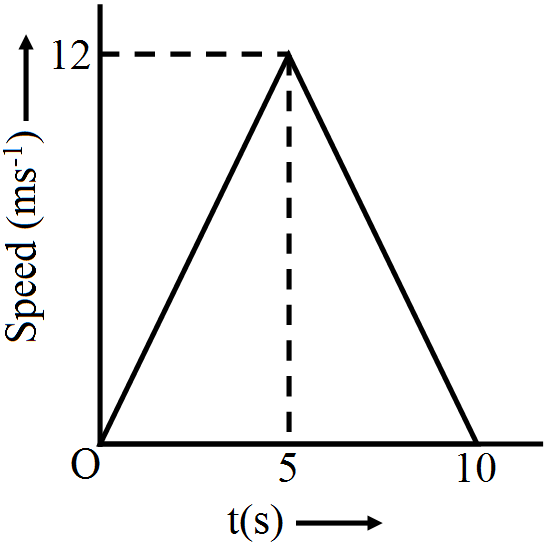
The speed time graph of a particle moving along a fixed direction is as shown below. Obtain the distance traversed by the particle between:
  1. $t = 0s$ to $5s$
  2. $t = 2s$ to $6s$
Two molecules of a gas have speeds of $9 \times 10^{16} ms^{-1}$ and $1 \times 10^6ms^{-1}$ respectively. What is the root mean square speed of these molecules?
Explain Doppler effect in sound. Obtain an expression for apparent frequency of sound when source and listener are approaching each other.
The magnetic field in a region is given by $\vec{\text{B}}=\vec{\text{k}}\frac{\text{B}_0}{\text{L}}\text{y}$ where L is a fixed length. A conductihg rod of of length lies along the Y-axis between the origin and the point (0, L, 0). If the rod moves with a velocity $\text{v}=\text{v}_0\vec{\text{i}},$ find the emf induced between the ends of the rod.
A group of clouds at a height of $500m$ above the earth burst and cause enough rainfall to cover an area of $106m$ 2 with a depth of $2cm$. How much work would have been done in raising water to the height of clouds?
A hammer of mass $M$ drops from a height $h.$ It strikes a nail placed vertically on the ground and drives it into the ground through a distance $D$. Calculate.
  1. The average resistance offered by the ground, assuming that the hammer and nail remain stuck together after impact.
  2. The time for which the nail is in motion and.
  3. The loss in kinetic energy in impact.
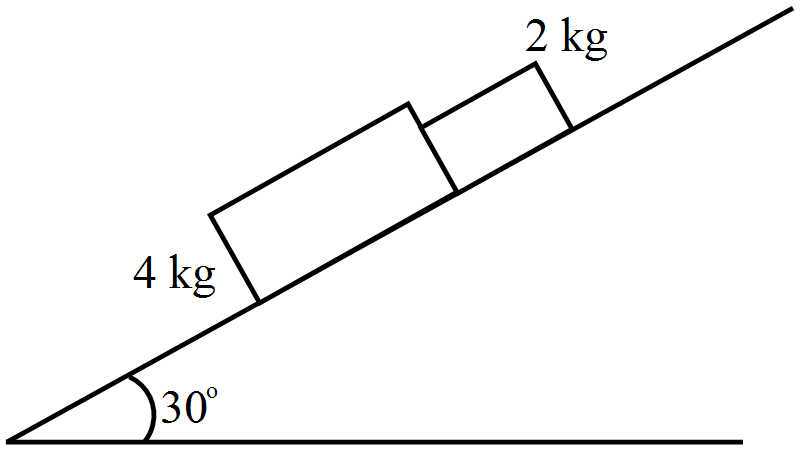
Figure shows two blocks in contact sliding down an inclined surface of inclination $30°$. The friction coefficient between the block of mass $2.0kg$ and the incline is $\mu_1,$ and that between the block of mass $4.0kg$ and the incline is $\mu_2.$ Calculate the acceleration of the 2.0kg block if:
  1. $\mu_1=0.20$ and $\mu_2=0.30$
  2. $\mu_1=0.30$ and $\mu_2=0.20$ Take $\text{g}=10\text{m/s}^2.$

State, for each of the following physical quantities, if it is a scalar or a vector : volume, mass, speed, acceleration, density, number of moles, velocity, angular frequency, displacement, angular velocity.
A ball is thrown horizontally from a point $100m$ above the ground with a speed of $20m/s$. Find:
  1. The time it takes to reach the ground.
  2. The horizontal distance it travels before reaching the ground.
  3. The velocity (direction and magnitude) with which it strikes the ground.