Question
  1. Given below are the steps for extraction of copper from its ore. Write the reaction involved.
    1. Roasting of copper (1) sulphide.
    2. Reduction of copper (1) oxide with copper (1) sulphide.
    3. Electrolytic refining.
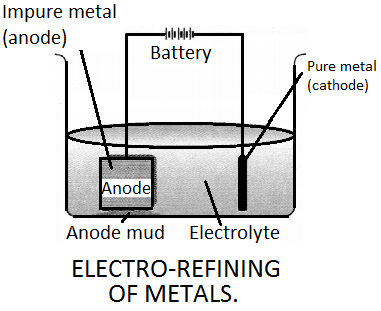
  2. Draw a neat and well labelled diagram for electrolytic refining of copper.
Answer

  1. Given below are the steps.
  1. Roasting:

$2\text{Cu}_2\text{S(s) + 3O}_2\text{(g)}\xrightarrow{\text{heat}}2\text{Cu}_2\text{O(s) + 2SO}_2\text{(g)}$

  1. Reduction:

$2\text{Cu}_2\text{O(s) + Cu}_2\text{S(s)}\xrightarrow{\text{heat}}6\text{Cu}\text{(s) + SO}_2\text{(g)}$

This reaction in which one of the reactants (Cu2S) carries the reduction of the product (Cu2O) is known as auto-reduction.

  1. Reactions taking place in electrorefensing are:

At cathode (reduction): Cu2+(aq) + 2e- → Cu(s)

At anode (oxidation): Cu(s) → Cu2+(aq) + 2e-

  1. For the diagram of electro-refining,

Need a full question paper?

Generate a complete, print-ready paper with questions like this in minutes — across 16+ boards, with answer keys.

Start Generating Free

Similar questions

State five uses of metals and five of non-metals.
  1. Draw magnetic field lines produced around a current carrying straight conductor passing through a cardboard. Name, state and apply the rule to mark the direction of these field lines.
  2. How will be strenght of the magnetic field change when the point where magnetic field is to be determined is moved away from the stright wire carrying constant current? Justify your answer.
  1. Write chemical equation for the following reactions:
  1. Calcium metal reacts with water.
  2. Cinnabar is heated in the presence of air.
  3. Manganese dioxide is heated with aluminium powder.
  1. What are alloys? List two properties of alloys.
Explain the cleansing action of soap. Draw diagrams to illustrate your answer.
An element A which is a part of common salt and kept under kerosene reacts with another element B of atomic number 17 to give a product C. When an aqueous solution of product C is electrolysed then a compound D is formed and two gases are liberated.
  1. What are A and B?
  2. Identify C and D.
  3. What will be the action of C on litmus solution? Why?
  4. State whether element B is a solid, liquid or gas at room temperature.
  5. Write formula of the compound formed when element B reacts with an element E having atomic number 5.
State any five physical properties of metals and five physical properties of non-metals.
When an object made of metal A is kept in air for a considerable time, it loses its shine and becomes almost black due to the formation of a layer of substance B. When an object made of another metal C is kept in damp air for a considerable time, it gets covered with a green layer of substance D. Metal A is the best conductor of electricity whereas metal C is the next best conductor of electricity.
  1. What is metal A?
  2. What is metal C?
  3. Name the substance B.
  4. Name the substance D.
  5. What type of chemical can be used to remove the green layer from metal C and clean it? Why?
Gas A, which is the major cause of global warming, combines with hydrogen oxide B in nature in the presence of an environmental factor C and a green material D to form a six carbon organic compounds E and a gas F. The gas F is necessary for breathing.
  1. What is gas A?
  2. What is the common name of B?
  3. What do you think could be C?
  4. What is material D? Where is it found?
  5. Name the organic compound E.
  6. What is gas F? Name the natural process during which it is released.
A salt X is formed and a gas is evolved when ethanoic acid reacts with sodium hydrogencarbonate. Name the salt X and the gas evolved. Describe an activity and draw the diagram of the apparatus to prove that the evolved gas is the one which you have named. Also, write chemical equation of the reaction involved.
What happens when zinc granules are treated with dilute solution of H2SO4 , HCl, HNO3, NaCl and NaOH, also write the chemical equations if reaction occurs.