MCQ
Given below are the two statements: one is labeled as Assertion $(A)$ and the other is labeled as Reason $(R)$.

Assertion $(A)$: There is a considerable increase in covalent radius from $\mathrm{N}$ to $\mathrm{P}$. However from $As$ to $Bi$ only a small increase in covalent radius is observed.

Reason $(R)$: covalent and ionic radii in a particular oxidation state increases down the group.

In the light of the above statement, choose the most appropriate answer from the options given below:

  • A
    $(A)$ is false but $(R)$ is true
  •  Both $(A)$ and $(R)$ are true but $(R)$ is not the correct explanation of $(\mathrm{A})$
  • C
     $(A)$ is true but $(R)$ is false
  • D
     Both $(A)$ and $(R)$ are true and $(R)$ is the correct explanation of $(A)$
Answer

Correct option: B.
 Both $(A)$ and $(R)$ are true but $(R)$ is not the correct explanation of $(\mathrm{A})$
b
According to $NCERT$,

Statement-$I$ : Factual data,

Statement-$II$ is true.

But correct explanation is presence of completely filled $d$ and f-orbitals of heavier members

Need a full question paper?

Generate a complete, print-ready paper with questions like this in minutes — across 16+ boards, with answer keys.

Start Generating Free

Similar questions

What is the molarity of pure water?
If equivalent conductance of $1\,M$ benzoic acid is $12.8\, ohm^{-1}\, cm^2\, eq^{-1}$ and if the equivalent conductances of benzoate ion and $H^+$ ion at infinite dilution are $42$ and $288.42\, ohm^{-1}\, cm^2\, eq^{-1}$ respectively, then its degree of dissociation is ............ $\%$
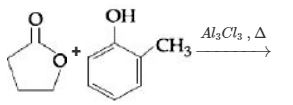
In this reaction, product $X$  is

$C{H_3} - C{H_2} - Br\xrightarrow{{{\text{alc}}{\text{.KCN}}}}$ $C{H_3}C{H_2}CN$$\xrightarrow{{{\text{HOH}}}}X$

The oxidation state of cobalt in the complex compound $\left[ {Co{{\left( {N{H_3}} \right)}_6}} \right]C{l_3}$ is
The major product of the following reaction is
$\begin{matrix}
   O\,\,\,\,\,\,\,\,\,\,\,\,\,\,\,\,\,\,\,\,\,\,\,\,\,\,\,\,\,\,\,\,\,\,\,\,\,\,\,\,\,\,\,\,\,\,\,\,\,\,\,  \\
   ||\,\,\,\,\,\,\,\,\,\,\,\,\,\,\,\,\,\,\,\,\,\,\,\,\,\,\,\,\,\,\,\,\,\,\,\,\,\,\,\,\,\,\,\,\,\,\,\,\,\,\,\,  \\
   R-C-O-R'+R''OH\overset{{{H}^{\oplus }}}{\longleftrightarrow}  \\
\end{matrix}\begin{matrix}
   O\,\,\,\,\,\,\,\,\,\,\,\,\,\,\,\,\,\,\,\,\,\,\,\,\,\,\,\,\,\,\,\,\,\,\,\,  \\
   ||\,\,\,\,\,\,\,\,\,\,\,\,\,\,\,\,\,\,\,\,\,\,\,\,\,\,\,\,\,\,\,\,\,\,\,\,  \\
   R-C-O-R''-R'OH  \\
\end{matrix}$

Above reaction is/an example of

Which is the correct sequence in the following, poperties? For the correct order mark $(T)$ and for the incorrect order mark $(F)$

$(a)$ Lewis acidity order : $SiF_4 < SiC_{4} < SiBr_4 < Sil_4$

$(b)$ Melting point : $NH_3 > SbH_3 > AsH_3 > PH_3$

$(c)$ Boiling point : $NH_3 > SbH_3 > AsH_3 > PH_3$

$(d)$ Dipole moment order : $NH_3 > SbH_3 > AsH_3 > PH_3$

Molar ionic conductivities of divalent cation and anion are $57 \mathrm{~S} \mathrm{~cm}^2 \mathrm{~mol}^{-1}$ and $73 \mathrm{~S} \mathrm{~cm}^2 \mathrm{~mol}^{-1}$ respectively. The molar conductivity of solution of an electrolyte with the above cation and anion will be :
When a reaction is progressing
Given the equilibrium constant $K_c$ of the reaction

$Cu(s) + 2Ag{^+}_{(aq)} \to Cu^{+2}_{(aq)} + 2Ag(s)$

is $10 \times 10^{15}$, calculate the $E_{cell}^o$ of the reaction of $298\,K$

[${2.303\,\frac{{RT}}{F}}$ at $298\,K$ $=0.059\,V$]