MCQ
Given below are two statement one is labeled as

Assertion $(A)$ and the other is labeled as Reason $(R)$. Assertion $(A)$: $\mathrm{CH}_2=\mathrm{CH}-\mathrm{CH}_2-\mathrm{Cl}$ is an example of allyl halide

Reason$(R)$: Allyl halides are the compounds in which the halogen atom is attached to $\mathrm{sp}^2$ hybridised carbon atom.

In the light of the two above statements, choose the $most \ appropriate$ answer from the options given below:

  • $(A)$ is true but $(R)$ is false
  • B
    Both $(A)$ and $(R)$ are true but $(R)$ is not the correct explanation of $(A)$
  • C
     $(A)$ is false but $(R)$ is true
  • D
    Both $(A)$ and $(R)$ are true and $(R)$ is the correctexplanation of $(A)$
Answer

Correct option: A.
$(A)$ is true but $(R)$ is false
a
$\mathrm{CH}_2=\mathrm{CH}-\mathrm{CH}_2-\mathrm{Cl}$

It is allyl carbon and $\mathrm{sp}^3$ hybridized

Need a full question paper?

Generate a complete, print-ready paper with questions like this in minutes — across 16+ boards, with answer keys.

Start Generating Free

Similar questions

Most acidic among the given acids
Which of the following oxides does not contain $N-N$ bond ?
If $X$  is the specific resistance of the solution and $M$  is the molarity of the solution, the molar conductivity of the solution is given by
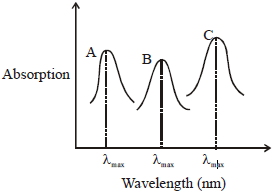
Simplified absorption spectra of three complexes $((i),$$( ii)$ and $( iii ))$ of $M ^{ n +}$ ion are provided below; their $\lambda_{\max }$ values are marked as $A, B$ and $C$ respectively. The correct match between the complexes and their $\lambda_{\max }$ values is

$(i)$ $\left[ M ( NCS )_{6}\right]^{(-6+ n )}$

$(ii)$ $\left[ MF _{6}\right]^{(-6+ n )}$

$(iii)$ $\left[ M \left( NH _{3}\right)_{6}\right]^{ n ^{+}}$

Methanol can be prepared when:
Resistance of a conductivity cell (cell constant $129 \;m ^{-1}$ ) filled with $74.5\; ppm$ solution of $KCl$ is $100\; \Omega$ (labelled as solution 1). When the same cell is filled with $KCl$ solution of $149 \;ppm$, the resistance is $50\; \Omega$ (labelled as solution 2). The ratio of molar conductivity of solution $1$ and solution $2$ is i.e. $\frac{\wedge_{1}}{\wedge_{2}}=x \times 10^{-3}$. The value of $x$ is

(Nearest integer)

Given, molar mass of $KCl$ is $74.5 g mol ^{-1}$

The reaction, water gas $(CO + {H_2}) + {H_2}\,\,673K,\,300$ atmosphere in presence of the catalyst $C{r_2}{O_3}/ZnO$ is used for the manufacture of
$\begin{array}{*{20}{c}}
  {2\,COOH} \\ 
  {|\,\,\,\,\,\,\,\,} \\ 
  {CHO}
\end{array}$ $\xrightarrow{{NaOH}}$ $\begin{array}{*{20}{c}}
  {COOH} \\ 
  {|\,\,\,\,\,\,\,\,\,\,\,} \\ 
  {\,\,\,\,\,\,\,\,C{H_2} - OH} 
\end{array}\,\,$    +    $\begin{array}{*{20}{c}}
  {COOH} \\ 
  {|\,\,\,\,\,\,\,\,\,\,\,} \\ 
  {\,\,\,\,\,\,\,\,COONa\,\,\,\,\,} 
\end{array}\,\,$ It is
A Faraday is:
$ArH + R - \mathop C\limits^{\mathop {||}\limits^O } - Cl\xrightarrow{{{\text{Lewis acid}}}}Ar - \mathop C\limits^{\mathop {||}\limits^O } - R + HCl$ is an example of