MCQ
Given below are two statements: One is labelled as Assertion $A$ and the other is labelled as Reason $R$.

Assertion $A:$ Two metallic spheres are charged to the same potential. One of them is hollow and another is solid, and both have the same radii. Solid sphere will have lower charge than the hollow one.

Reason $R:$ Capacitance of metallic spheres depend on the radii of spheres.

In the light of the above statements, choose the correct answer from the options given below.

  • $A$ is false but $R$ is true
  • B
    Both $A$ and $R$ are true and $R$ is the correct explanation of $A$
  • C
    $A$ is true but $R$ is false
  • D
    Both $A$ and $R$ are true but $R$ is not the correct explanation of $A$
Answer

Correct option: A.
$A$ is false but $R$ is true
a
Potential of a conducting sphere is

$V =\frac{ KQ }{ R } \text { (Solid as well as hollow) }$

$V _1= V _2 \text { and } R _1= R _2$

$\therefore Q _1= Q _2$

Need a full question paper?

Generate a complete, print-ready paper with questions like this in minutes — across 16+ boards, with answer keys.

Start Generating Free

Similar questions

Two resistances ${R_1}$ and ${R_2}$ when connected in series and parallel with $120\, V$ line, power consumed will be $25\, W$ and $100\, W$ respectively. Then the ratio of power consumed by ${R_1}$ to that consumed by ${R_2}$ will be
A particle of mass $5 \;\mathrm{m}$ at rest suddenly breaks on its own into three fragments. Two fragments of mass $m$ each move along mutually perpendicetion with speed $v$ each. The energy released during the process is
Two satellites of masses ${m_1}$ and ${m_2}({m_1} > {m_2})$ are revolving round the earth in circular orbits of radius ${r_1}$ and ${r_2}({r_1} > {r_2})$ respectively. Which of the following statements is true regarding their speeds ${v_1}$ and ${v_2}$ ?
Three liquids with masses ${m_1},\,{m_2},\,{m_3}$ are thoroughly mixed. If their specific heats are ${c_1},\,{c_2},\,{c_3}$ and their temperatures ${T_1},\,{T_2},\,{T_3}$ respectively, then the temperature of the mixture is
Two masses of $0.25\, kg$ each moves towards each other with speed $3\, ms^{-1}$ and $1\, ms^{-1}$. Then they collide and stick together. Find the final velocity .............. $\mathrm{m} \mathrm{s}^{-1}$
Carbon-$11$ decays to boron-$11$ according to the following formula.

${ }_6^{11} C \rightarrow{ }_5^{11} B +e^{+}+ v _e+0.96 \,MeV$

Assume that, positrons $\left(e^{+}\right)$produced in the decay combine with free electrons in the atmosphere and annihilate each other almost immediately. Also, assume that the neutrinos $\left(v_e\right)$ are massless and do not interact with the environment. At $t=0$, we have $1 \mu g$ of ${ }_6^{12} C$. If the half-life of the decay process is $t_0$, the net energy produced between time $t=0$ and $t=2 t_0$, will be nearly ........... $MeV$

Two infinitely long parallel wires carry currents of magnitude $I_1$ and $I_2$ are at a distance $4 cm$ apart. The magnitude of the net magnetic field is found to reach a non-zero minimum value between the two wires and $1 \,cm$ away from the first wire. The ratio of the two currents and their mutual direction is
If a spring of stiffness $k$ is cut into two parts $A$ and $B$ of length $l_{A}: l_{B}=2: 3$, then the stiffness of spring $A$ is given by
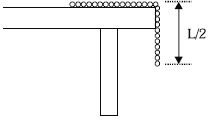
A uniform chain (mass $M,$ length $L$) is released from rest from a smooth horizontal surface as shown in the figure. Velocity of the chain at the instant it completely comes out of the table will be
A disc arranged in a vertical plane has two groves of same length directed along the vertical chord $AB$ and $CD$ as shown in the fig. The same particles slide down along $AB$ and $CD$. The ratio of the time $t_{AB}/t_{CD}$ is