MCQ
Given below are two statements, one is labelled as Assertion $A$ and the other is labelled as Reason $R$.

Assertion $A:$ The spin only magnetic moment value for $\left[ Fe ( CN )_6\right]^{3-}$ is $1.74 BM$, whereas for $\left[ Fe \left( H _2 O \right)_6\right]^{3+}$ is $5.92\,BM$.

Reason $R :$ In both complexes, $Fe$ is present in +3 oxidation state.

In the light of the above statements, choose the correct answer from the options given below:

  • Both $A$ and $R$ are true but $R$ is NOT the correct explanation of $A$
  • B
    $A$ is false but $R$ is true
  • C
    $A$ is true but $R$ is false
  • D
    Both $A$ and $R$ are true and $R$ is the correct explanation of $A$
Answer

Correct option: A.
Both $A$ and $R$ are true but $R$ is NOT the correct explanation of $A$
a
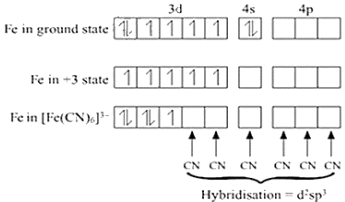
Unpaired electron $=1$

$\mu=\sqrt{ n ( n +2)}=\sqrt{1 \times 3}=1.74 \text { B.M. }$

$\left[ Fe \left( H _2 O \right)_6\right]^{3+}$ No pairing because $H _2 O$ is WFL Number of unpaired electrons $=5, \mu=5.92\,BM$ Assertion is true, Reason is true but not correct explanation.

Need a full question paper?

Generate a complete, print-ready paper with questions like this in minutes — across 16+ boards, with answer keys.

Start Generating Free

Similar questions

Identify correct $A, B$ and $C$ in the reaction sequence given below
The standard enthalpies of combustion of $C_6H_{6(l)}, C_{(graphite)}$ and $H_{2(g)}$ are respectively $-3270\, kJ\, mol^{-1}, -394\, kJ\, mol^{-1}$ and $-286\, kJ\, mol^{-1}$. What is the standard enthalpy of formation of $C_6H_{6(l)}$ in $kJ\, mol^{-1}$ ?
Which of the following have both polar and non-polar bonds
$R-COOH$ $\xrightarrow{{\operatorname {Reagent}}}$ $R-CH_2-OH$

suitable reagent for the above conversion is

$\xrightarrow[\Delta ]{{alc.\,KOH}}$ product
In the Newman projection for $2,2$-dimethylbutane $Image$ ${X}$ and ${Y}$ can respectively be

$(A)$ $\mathrm{H}$ and $\mathrm{H}$

$(B)$ $\mathrm{H}$ and $\mathrm{C}_2 \mathrm{H}_5$

$(C)$ $\mathrm{C}_2 \mathrm{H}_5$ and $\mathrm{H}$

$(D)$ $\mathrm{CH}_3$ and $\mathrm{CH}_3$

Assuming the bond direction to the $z$ -axis, which of the overlapping of atomic  orbitals of two atom $(A)$ and $(B)$ will result in bonding?

$(I)\, s-$ orbital of $A$ and $P_x$ -orbital of $B$

$(II)\, s-$ orbital of $A$ and $P_z$ orbital of $B$

$(Ill)\, p_y$ -orbital of $A$ and $p_z$ orbital of $B$

$(IV)\, s-$ orbital of both $(A)$ and $(B)$

The Total pressure observed by mixing two liquid $A$ and $B$ is $350\,mm\,Hg$ when their mole fractions are $0.7$ and $0.3$ respectively.The Total pressure becomes $410 \,mm\,Hg$ if the mole fractions are changed to $0.2$ and $0.8$ respectively for $A$ and $B$. The vapour pressure of pure $A$ is $...........\,mm\,Hg$. (Nearest integer)

Consider the liquids and solutions behave ideally.

Formation of diethyl ether from ethanol is based on a
${C_6}{H_6}\mathop {\xrightarrow{{HN{O_3}}}}\limits_{{H_2}S{O_4}} X\mathop {\xrightarrow{{C{l_2}}}}\limits_{FeC{l_3}} Y$. In the above sequence  $ Y$  is