MCQ
Given below are two statements $:$ one is labelled as
Assertion $(A)$ and the other is labelled as Reason $(R).$
Assertion $(A) :$ In aqueous solutions $Cr^{2+}$ is reducing while $Mn^{3+}$ is oxidising in nature.
Reason $(R) :$ Extra stability to half filled electronic
configuration is observed than incompletely filled electronic configuration.
In the light of the above statement, choose the most appropriate answer from the options given below:
  • A
    Both (A) and (R) are true and (R) is the correct explanation of (A)
  • B
    Both (A) and (R) are true but (R) is not the correct explanation of (A)
  • C
    (A) is false but (R) is true
  • D
    (A) is true but (R) is false

Answer

$Cr^{2+}$ is reducing as it configuration changes from $d^4$ to $d^3$ due to formation of $Cr^{3+},$ which has half filled $t_{2g}$ level, on other hand, the change $Mn^{3+}$ to $Mn^{2+}$ result half filled $d^5$ configuration which has extra stability.

Need a full question paper?

Generate a complete, print-ready paper with questions like this in minutes — across 16+ boards, with answer keys.

Start Generating Free

Similar questions

With respect to hypochlorite, chlorate and perchlorate ions, choose the correct statement($s$).

$(A)$ The hypochlorite ion is the strongest conjugate base.

$(B)$ The molecular shape of only chlorate ion is influenced by the lone pair of electrons of $Cl$.

$(C)$ The hypochlorite and chlorate ions disproportionate to give rise to identical set of ions.

$(D)$ The hypochlorite ion oxidizes the sulfite ion.

......$m$ sodium acetate should be added to a $0.1\,\,m$ solution of $C{H_3}COOH$ to give a solution of $pH = 5.5\,(p{K_a}$ of $C{H_3}COOH = 4.5)$
The group having isoelectronic species is :
What will be the decreasing order of basic strength of the following conjugate bases?

${ }^{-} \mathrm{OH}, \mathrm{R} \overline{\mathrm{O}}, \mathrm{CH}_3 \mathrm{CO} \overline{\mathrm{O}}, \mathrm{C} \overline{1}$

In which of the following is the angle between the two covalent bonds greatest
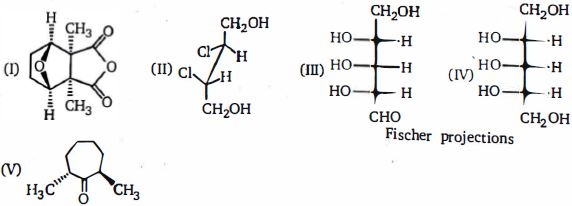
Which of the structures given' below are chiral ?
Which of the following substances has covalent bonding
Which of the following relations are correct?

$(A)$ $\Delta U = q + p \Delta V$

$(B)$ $\Delta G =\Delta H - T \Delta S$

$(C)$ $\Delta S =\frac{ q _{ rev }}{ T }$

$(D)$ $\Delta H =\Delta U -\Delta nRT$

Choose the most appropriate answer from the options given below :

What, if anything, can be said about the magnitude' of the equilibrium constant $K$ for the following equilibrium ?
In the equilibrium reaction 

$AgCl(s) + 2N{H_3}(aq.) \rightleftharpoons Ag{(N{H_3})_2}^ + (aq) + C{l^ - }(aq.)$

Increase in the concentration of $Cl^-(aq.)$ causes