MCQ
Given below are two statements: one is labelled as Assertion $(A)$ and the other is labelled as Reason $(R).$

Assertion $(A) :$ Metallic character decreases and non-metallic character increases on moving from left to right in a period.

Reason $(R)$ $:$ It is due to increase in ionisation enthalpy and decrease in electron gain enthalpy, when one moves from left to right in a period.

In the light of the above statements, choose the most appropriate answer from the options given below :

  • A
    $(A)$ is false but $(R)$ is true.
  • $(A)$ is true but $(R)$ is false
  • C
    Both $(A)$ and $(R)$ are correct and $(R)$ is the correct explanation of $(A)$
  • D
    Both $(A)$ and $(R)$ are correct but $(R)$ is not the correct explanation of $(A)$
Answer

Correct option: B.
$(A)$ is true but $(R)$ is false
b
$I$. In $p-$Block both metals and non metals are present but in $d$-Block only metals are present.

$II$. $EN$ and $IE$ of non metals are greater than that of metals

$I$ - False, $II$-True

Need a full question paper?

Generate a complete, print-ready paper with questions like this in minutes — across 16+ boards, with answer keys.

Start Generating Free

Similar questions

The $d-$ orbitals which are involved in hybridisation of central atom in $ICl_4^-$
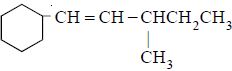
The $IUPAC$ name of given compound is :
For a diatomic ideal gas in a closed system, which of the following plots does not correctly describe the relation between various thermodynamic quantities?
The quantum number/s needed to describe an electron fully in an atom is/are:
In which block $106$$^{th}$ element belongs
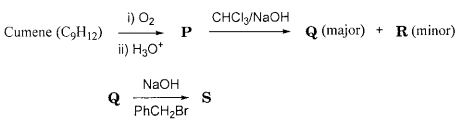
The correct statement($s$) about the following reaction sequence is(are)

(image)

($A$) $R$ is steam volatile

($B$) $Q$ gives dark violet coloration with $1 \%$ aqueous $FeCl_3$ solution

($C$) $S$ gives yellow precipitate with $2, 4$-dinitrophenylhydrazine

($D$) $S$ gives dark violet coloration with $1 \%$ aqueous $FeCl_3$ solution

Consider the following reactions in which all the reactants and products are in gaseous state

${\text{2PQ}} \rightleftharpoons {{\text{P}}_2}{\text{  +  }}{{\text{Q}}_2}\,;\,\,\,\,{{\text{K}}_1}{\text{ =  2}}{\text{.5 }} \times \,{\text{1}}{{\text{0}}^5}\,$

${\text{PQ + }}\frac{1}{2}{R_2} \rightleftharpoons PQR\,;\,\,\,\,{{\text{K}}_2}{\text{ =  5 }} \times \,{\text{1}}{{\text{0}}^{ - 3}}\,$

The value of equilibrium constant for reaction

$\frac{1}{2}{{\text{P}}_2}{\text{ + }}\frac{1}{2}{{\text{Q}}_2}{\text{ + }}\frac{1}{2}{R_2} \rightleftharpoons PQR\,$ is

In the periodic table, the metallic character of elements
Calculate the partial pressure of carbon monoxide from the following ;

${K_p} = 8 \times {10^{ - 2}}$$C{O_{2(g)}} + {C_{(s)}} \to 2C{O_{(g)}}$ ; ${K_p} = 2$

$CaC{{O}_{3(s)}}\xrightarrow{\Delta }Ca{{O}_{(s)}}+C{{O}_{2}}\uparrow $;  ${{K}_{p}}=8\times {{10}^{-2}}$

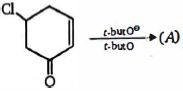
$"(A)"$ is